
March 13, 2026
How Many Miles Is An 8K Run: Deciphering The Distance
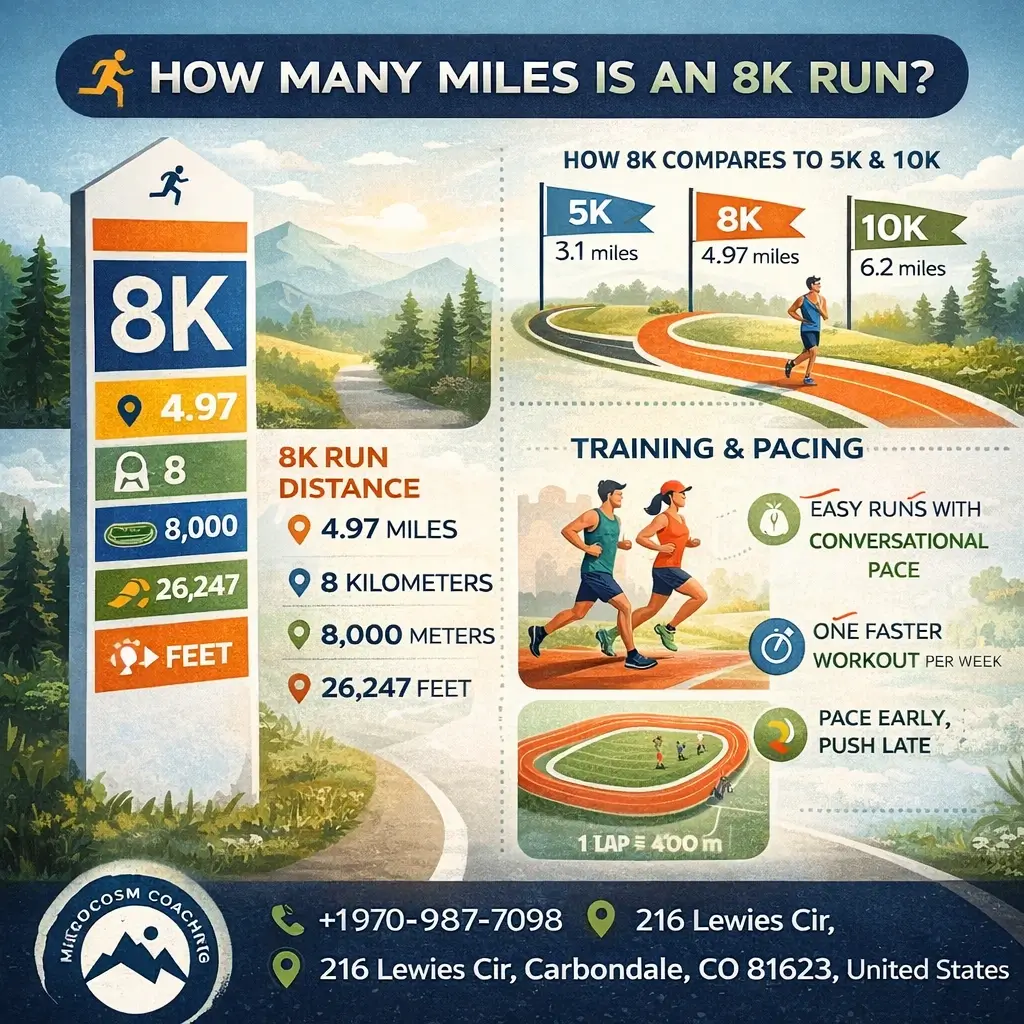
An 8K run is 4.97 miles. That’s the simplest, most accurate answer—and it’s why you’ll often hear runners call it “basically a 5-mile race.” Officially, an 8K is 8 kilometers, which equals 8,000 meters, and it lands just a hair under five miles.
If you’re signing up for an 8K, training for one, or trying to understand where it fits between a 5K and a 10K, this guide will break it down in plain language. You’ll get the exact conversion, a few easy ways to visualize the distance, what it feels like compared to other common races, and how to train for an 8K without overcomplicating it.
The Exact 8K Distance (Miles, KM, Meters, Feet)
Let’s lock in the numbers so there’s no confusion.
An 8K means 8 kilometers. One kilometer equals 1,000 meters, so:
-
8K = 8 km
-
8K = 8,000 meters
-
8K ≈ 4.97 miles
That “4.97” is why people casually call it a 5-mile race. It’s close enough that rounding feels natural, but if you want precision, 4.97 miles is the correct conversion.
If you like thinking in feet (some runners do, especially when they’re visualizing a course), an 8K is roughly 26,247 feet. That number isn’t essential for training, but it can help you grasp that the distance is substantial—especially if you’re new to running.
So, if you’re asking “How many miles is an 8K run?” the accurate answer is:
4.97 miles (just under 5 miles).
Why 8K Feels Like A “Nearly 5-Mile” Race
The difference between 4.97 miles and 5.00 miles is small—about 0.03 miles, which is roughly 158 feet. For most runners, that’s the distance between a couple of driveway lengths or a quick jog down the block. It’s not enough to change how you train in any major way.
But it can change how you pace at the end. If you go out too hard treating it like a short race, the final mile can feel longer than you expect. That’s part of what makes the 8K such a useful and honest distance: it’s short enough to race hard, but long enough to punish pacing mistakes.
In practical terms, you should treat an 8K like a “strong, steady effort with a sting at the end.” It’s not as explosive as a 5K. It’s not as grindy as a 10K. It’s right in the middle.
8K Compared To 5K And 10K
If you’ve run a 5K or 10K before, the easiest way to understand an 8K is to see where it sits between them.
5K vs 8K
A 5K is 3.1 miles, and it’s often more speed-weighted. Even if you’re a newer runner, a 5K can feel like a “controlled sprint” because the finish arrives quickly. You can push hard early and sometimes survive the consequences.
An 8K is different. It adds nearly two more miles. That doesn’t sound like much on paper, but it changes the pacing strategy. An 8K asks for more aerobic strength and more patience. Going out too fast becomes more expensive. You can still race it aggressively, but you have to be smarter about how you spend energy.
A good mental model is this: a 5K is about holding on; an 8K is about settling in, staying smooth, and then pushing when you’ve earned it.
8K vs 10K
A 10K is 6.2 miles, which brings a more sustained discomfort. It’s long enough that even strong runners need to manage effort carefully. The 10K often feels like a longer, heavier version of the “comfortably hard” zone.
The 8K is slightly shorter, which makes it feel more approachable for runners stepping up from a 5K. It’s still a meaningful jump in endurance, but it doesn’t require the same level of sustained grinding. That’s why 8Ks are common as bridge races—especially in cross-country settings and early-season road racing.
If you’re building toward a 10K or half marathon, the 8K is a great “test distance” to learn pacing and build confidence.
How Far Is An 8K On A Track?
Sometimes the best way to understand a distance is to visualize it.
A standard outdoor track is 400 meters per lap. Since an 8K is 8,000 meters, you divide:
8,000 ÷ 400 = 20 laps
So an 8K is 20 laps around a standard track.
That’s a useful visual because it highlights the nature of the race. Twenty laps is long enough that pacing discipline matters. If you start too fast, you’ll feel it before you’re halfway. If you stay controlled, you can build momentum and finish strong.
If you’ve ever done a track workout and felt like “this is already a lot,” imagine doing twenty laps without stopping. That’s the 8K: a real endurance effort with racing intensity layered in.
Is An 8K Considered A Long-Distance Run?
This is one of the most common questions runners ask, and the honest answer is: it depends on your context.
For a brand-new runner, an 8K can absolutely feel like long distance. Running nearly five miles continuously is a big achievement if you’re just learning to build endurance. It requires patience, steady pacing, and enough aerobic fitness to keep moving without your form falling apart.
For experienced endurance runners, an 8K is usually considered a middle distance. Many marathoners and trail runners run 8K as an easy run. The race still matters—racing 8K hard is a different thing than jogging it—but the distance itself isn’t “long” in the ultra sense.
A better way to think about it is this: “long” is not a fixed number. “Long” is whatever pushes the edge of your current capacity.
If you’re training consistently and your weekly volume is growing, an 8K may feel like a moderate effort. If you’re new or returning after time off, it may feel like a serious challenge. Both are valid. The distance doesn’t change. Your relationship to it does.
How Long Does It Take To Run An 8K?
Finish times vary widely based on experience, fitness, course, and pacing. A helpful way to think about 8K time is that it often falls between typical 5K and 10K performance.
Many newer runners might finish an 8K in roughly 45 to 60+ minutes, depending on their pace and whether they take walk breaks. Intermediate runners often land in the 35 to 45 minute range. Faster runners may finish in the low 30s or under, especially on flat courses.
Instead of fixating on a specific number, focus on what affects your time most:
Your aerobic base (how consistently you’ve been running)
Your pacing strategy (starting too fast is the biggest time killer)
Course factors (hills, wind, heat, turns)
How well you recover (sleep and stress matter more than people admit)
If you’re running your first 8K, a smart goal is to run steady, stay relaxed early, and finish feeling proud rather than destroyed. The fastest way to improve over time is to make the experience sustainable.
How To Train For An 8K (Simple And Sustainable)
The best 8K training plan is one you can actually stick to. You don’t need to train like a professional. You need consistent running, mostly easy, with a small amount of faster work to build speed endurance.
A simple approach is to build training around three pillars:
Build The aerobic base with easy runs
Most of your runs should feel conversational. Easy running builds endurance, strengthens connective tissue, and helps your body handle volume without breaking down. This is where long-term progress comes from.
Add one “quality” session per week
This doesn’t need to be extreme. It could be short intervals, hill repeats, or a steady effort that teaches you to run “strong but controlled.” The point is to introduce some discomfort in a structured way, not to crush yourself.
Include one longer run each week
Over time, gently build a weekly run that extends beyond 8K distance. If you can comfortably run 5–6 miles in training, an 8K race feels much more manageable. This long run should still be easy. It’s about endurance, not proving speed.
If you’re new, you can progress gradually with run/walk segments. That doesn’t make the training less legitimate. It makes it sustainable.
How to pace an 8K
A strong 8K is usually run with control early. You want to feel like you’re working, but not like you’re sprinting. The effort should feel steady and “focused.” You should be able to speak short phrases, not full sentences.
If you’re new to racing, the best strategy is almost always to start slightly slower than you think, settle into rhythm, and then push in the last 1–2 miles. Most runners do the opposite and pay for it.
Common Confusions (Cleared Up)
Is 8K 10 miles?
No. This is a common misunderstanding, especially for runners who aren’t used to kilometers. An 8K is 4.97 miles, which is about half of 10 miles. If you’re thinking of 10 miles, that’s closer to 16K, not 8K.
Is an 8K harder than a 5K?
It depends on how you race it. A 5K is usually raced at a higher intensity, so it can feel more painful per minute. An 8K is longer, so it requires more endurance and better pacing. Many runners find the 8K “harder” because there’s more time for fatigue to build and less room for early mistakes.
Is an 8K closer to a 5K or a 10K?
In distance, it’s closer to a 10K than a 5K, but in feel it can sit right between them. If you’re strong aerobically, it may feel more like a controlled 10K. If you’re speed-oriented, it might feel like a long 5K. That’s why it’s such a useful bridge distance.
A Microcosm Coaching Note
At Microcosm Coaching, we love distances like the 8K because they teach runners how to train with patience and race with awareness. We’re a human-first, subscription-based virtual coaching team that supports athletes through a coach-led feedback loop—daily check-ins, individualized planning, and ongoing adjustments based on real life (sleep, stress, work, and recovery). If you’re building toward your first 8K or trying to race one faster, the goal isn’t just to finish this event—it’s to become the kind of runner who can build fitness sustainably and keep enjoying the process long-term.
FAQs: How Many Miles Is An 8K Run?
How many miles are in an 8K run?
An 8K run is 4.97 miles.
How far is an 8K run in kilometers?
An 8K is 8 kilometers.
How many meters is an 8K?
An 8K is 8,000 meters.
How many laps is an 8K on a standard track?
An 8K is 20 laps on a 400-meter track.
Is an 8K considered a long-distance run?
For new runners, yes—it’s a meaningful endurance effort. For experienced runners, it’s more of a middle distance. It depends on your training context.
Is 8K 10 miles?
No. An 8K is about 5 miles, not 10.
How should I pace an 8K?
Start controlled, settle into a steady rhythm, and aim to finish stronger in the last 1–2 miles. Most runners go out too fast; patience pays off.
Is an 8K closer to a 5K or a 10K?
In distance it’s closer to a 10K, but it often feels like a bridge between the two—more endurance than a 5K, less grind than a 10K.