
October 8, 2026
California International Marathon: Course Analysis and Pacing Strategy Guide
The California International Marathon has a reputation as one of the fastest marathon courses in the United States. Its point-to-point route from Folsom to Sacramento offers a significant net elevation loss, cool December racing conditions, and a finish near the California State Capitol.
But CIM is not simply 26.2 miles of easy downhill running. The first two-thirds of the course contain repeated rolling hills and descents that can quietly wear down your legs. If you attack those early miles because your watch is showing fast splits, the final 10K can become much harder than expected.
A successful CIM pacing strategy is about patience. Run the early hills by effort, protect your legs on the descents, fuel consistently, and arrive at the final miles with enough strength left to race.
Is the California International Marathon Course Fast?
Yes, CIM can be a very fast marathon course. The overall elevation trend works in your favor, and the later miles become increasingly runnable as you approach Sacramento.
That combination makes CIM attractive to runners chasing personal records and Boston qualifying times. But the fastest runners on this course are not necessarily the ones who take the most advantage of the early downhill miles. They are often the runners who manage them most intelligently.
The important distinction is that CIM is net downhill, not continuously downhill. You will encounter frequent rollers, particularly during the earlier and middle portions of the race. Your pace may fluctuate even when your effort remains steady.
Understanding that difference before race day can prevent one of the most common CIM mistakes: trying to force goal marathon pace on every single mile.
CIM Course Elevation and Terrain Explained
The California International Marathon begins near Folsom and gradually works west toward Sacramento. Although there is considerably more descending than climbing across the full course, the elevation profile contains enough rolling terrain to challenge runners who expect a smooth downhill race.
The best way to approach CIM is to think of the course in phases. Each portion asks something slightly different from your pacing, technique, and decision-making.
Miles 1–5: Stay Patient
Race-day adrenaline makes the opening miles especially dangerous. Your legs are fresh, the field is moving quickly, and downhill sections can make a pace faster than your goal feel surprisingly comfortable.
Let the terrain help you, but do not deliberately push to bank time.
Your breathing should feel controlled, your stride relaxed, and your effort slightly easier than what you expect later in the race. If you are chasing a specific finish time, resist the urge to panic because one uphill mile comes in a few seconds slower than goal pace.
Those seconds are inexpensive early. Trying to recover them immediately can become very expensive later.
Miles 6–10: Run the Hills by Effort
As the rolling terrain continues, stop treating every mile split as a test of whether you are on pace.
Allow yourself to slow naturally while climbing. Keep your cadence comfortable, shorten your stride slightly, and avoid turning each hill into a threshold effort. When the road tips downward again, let your speed increase naturally without aggressively charging the descent.
This is where understanding a broader marathon pacing strategy becomes especially valuable. Marathon pace is not necessarily one rigid number you must hit regardless of terrain.
The goal is sustainable output across 26.2 miles.
Should You Slow Down on the CIM Hills?
Yes. A slower split on an uphill section can be exactly the right decision.
Trying to hold perfectly even pace uphill requires more energy than maintaining steady effort. That extra work increases fatigue, carbohydrate use, and muscular stress at a point when you still have many miles left to run.
If an uphill mile comes in 10 or 15 seconds slower than expected, you do not need to immediately recover that time on the next descent.
Instead, return to your normal effort and let the course come back to you naturally.
Miles 10–16: Protect Your Legs
The middle section is where patience becomes increasingly important. Aerobically, you may still feel excellent. Muscularly, however, the repeated ups and downs are beginning to accumulate.
Downhill running creates substantial eccentric loading through the quadriceps as your muscles work to control each landing. You may not notice the damage immediately, which is part of what makes aggressive downhill running so tempting.
Maintain good posture and quick, controlled steps rather than reaching forward with a long stride. Our guide to proper downhill running technique goes deeper into how to use descents efficiently without unnecessarily beating up your legs.
This is also not the moment to forget about fueling because you feel good. Keep following the nutrition strategy you practiced in training.
Miles 16–20: Settle Into Your Race
As the terrain becomes more favorable, CIM begins to reward the restraint you showed earlier.
Instead of automatically accelerating at mile 16, take inventory. Is your breathing controlled? Are your shoulders relaxed? Are you maintaining cadence? Have you stayed on top of fuel and fluids?
If everything feels good, gradually settle more firmly into goal marathon effort.
Runners chasing a PR or Boston qualifier sometimes make the mistake of believing they must build a large time cushion early. A much stronger strategy is arriving here close to your target with legs that are still capable of maintaining pace.
Miles 20–26.2: Start Racing
The final 10K is where smart CIM pacing can pay off.
By this point, the terrain is more runnable and Sacramento is getting closer. The question is no longer how much energy you need to protect for later. The question is how much you can sustainably use now.
If you are feeling strong, begin increasing effort gradually. Keep your posture tall and focus on cadence rather than dramatically lengthening your stride.
You do not need a huge finishing surge at mile 20. Think of the final six miles as a progressive commitment. Hold your rhythm first, then increase effort as the finish approaches.
The goal is to arrive at mile 20 ready to race, not simply ready to survive.
What Is the Best CIM Pacing Strategy?
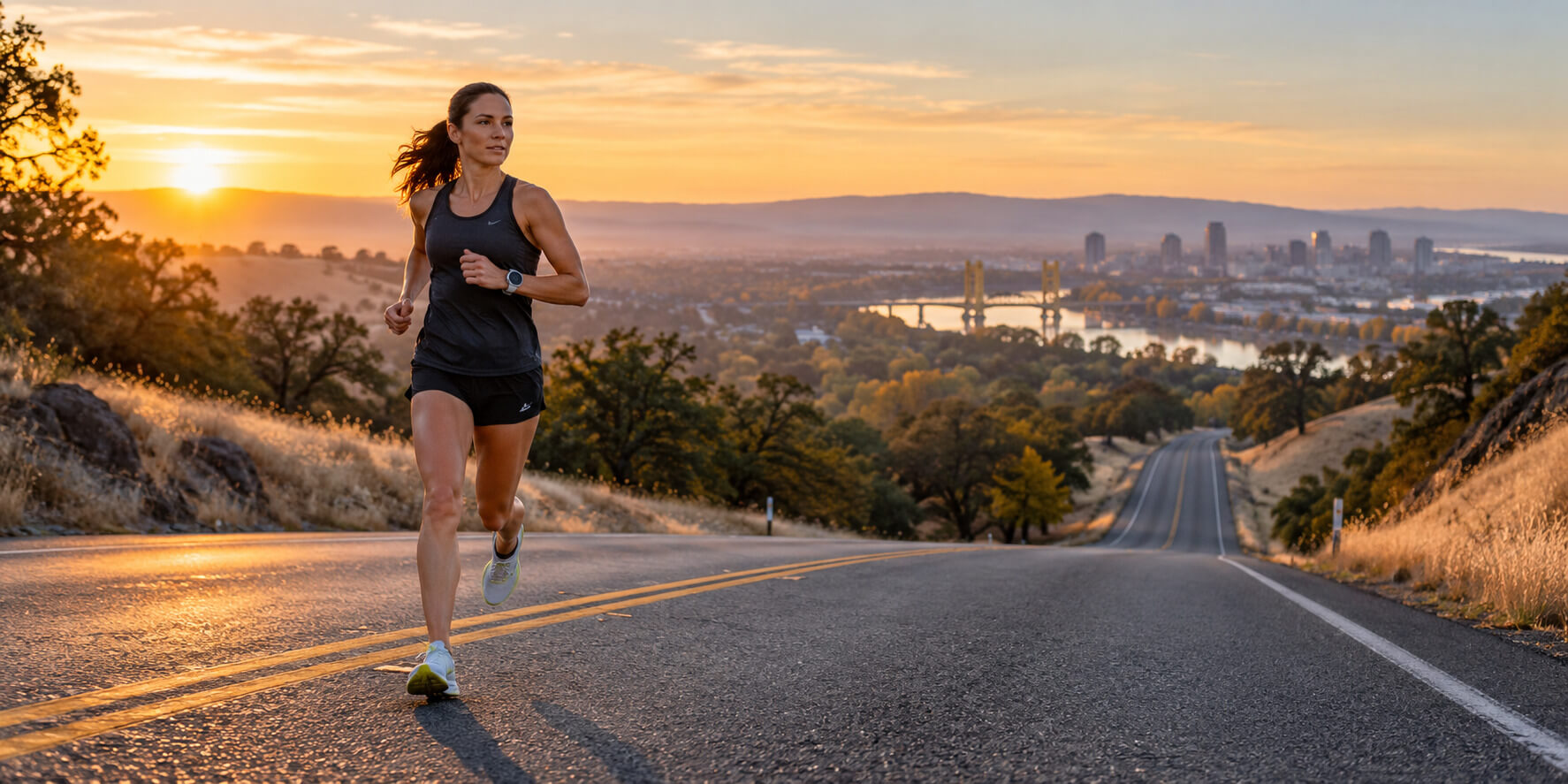
For most runners, even effort is more useful than perfectly even pace at CIM.
Your actual mile splits may move above and below goal pace because of the rolling terrain. That does not mean your race strategy is failing.
A simple framework is:
- Uphill: Accept a slightly slower pace while keeping effort controlled.
- Downhill: Allow a naturally faster pace without forcing the descent.
- Flatter sections: Settle back toward goal marathon pace.
- Final 10K: Increase effort if your legs, fueling, and breathing remain under control.
This approach is more sustainable than fighting the terrain for identical splits.
Should You Negative Split CIM?
A slight negative split can work extremely well at CIM, but you do not need to deliberately crawl through the first half hoping to produce a massive second-half comeback.
Think instead in terms of controlled start, steady middle, strong finish.
Your early pace should reflect the terrain and your fitness. If you can reach the final 10K feeling like you still have another gear available, you have created an opportunity to negative split naturally.
Pacing CIM for a Boston Qualifier
CIM is popular among athletes chasing Boston qualifying times, and the fast overall course makes that understandable.
The mistake is treating your desired qualification buffer as time that must be accumulated immediately.
If you are pursuing a BQ, know your target average pace before race day, but evaluate your performance across larger sections rather than obsessing over individual miles. Rolling terrain will create variation.
If Boston is your longer-term target, understanding how to qualify for the Boston Marathon can help you set a realistic goal before deciding exactly how aggressively to race CIM.
Should You Follow a CIM Pace Group?
A pace group can be useful if its target closely matches your goal. Running with a group can reduce some of the mental work of checking your watch and provide valuable energy and support during difficult portions of the race.
However, do not outsource every race-day decision to the pacer.
If the group charges an uphill harder than feels appropriate, you do not need to follow blindly. Similarly, avoid making an abrupt surge simply because you briefly drift a few seconds behind.
Use a pace group as a tool, not a replacement for awareness of your own effort.
How to Train for the CIM Course
CIM preparation should reflect the course you will actually race. Running only flat roads at perfectly even pace leaves an important gap in your preparation.
Include rolling terrain during long runs and learn how to adjust effort naturally across hills. Controlled downhill running can gradually improve your tolerance for the eccentric loading that becomes important later in the race.
Strength training can also support your ability to maintain form as fatigue builds. Your quads, glutes, hamstrings, calves, and trunk all contribute to staying efficient late in a marathon.
Some long runs can include marathon-specific work after you already have fatigue in your legs. The exact mileage and workout structure should reflect your experience rather than copying someone else’s schedule. If you are still building your plan, consider how many miles per week you should run for marathon training alongside your race-specific sessions.
Fueling for the California International Marathon
A fast course does not reduce your fueling requirements.
Begin fueling before you feel depleted and continue taking carbohydrates according to the strategy you practiced during training. Waiting until mile 18 because you still feel good can leave you trying to correct an energy problem that developed much earlier.
Race week matters too. Arriving with adequate glycogen stores gives you a stronger starting point, which is why having a deliberate marathon carb-loading strategy can be valuable before CIM.
Do not introduce unfamiliar gels, drinks, or breakfast foods on race morning. Your nutrition plan should already feel routine by the time you arrive in Folsom.
Personalized California International Marathon Coaching
At Microcosm Coaching, marathon preparation is built around the athlete rather than forcing every runner into the same schedule. Our California International Marathon coaching can account for your current fitness, goal time, training history, work and family schedule, recovery, fueling, and how your body responds to hills and downhill running. The goal is not simply to accumulate mileage. It is to arrive at CIM healthy, prepared, and confident enough to make good decisions when the race starts.
Race CIM With Patience First
CIM can absolutely be a fast marathon. But the net downhill profile only helps if your legs are still working when you reach Sacramento.
Start controlled. Let your pace change naturally with the rolling terrain. Avoid fighting the hills or attacking every descent. Fuel early, protect your legs through the middle miles, and save your strongest racing for the final portion of the course.
Your best CIM may feel almost too conservative at mile five and exactly right at mile 22.
FAQs About the California International Marathon Course
Is the California International Marathon Course Hilly?
CIM is a net-downhill course, but it contains repeated rolling hills, particularly through the early and middle miles. Runners should prepare for both climbing and descending rather than expecting a continuous downhill route.
Is CIM a Fast Marathon Course?
Yes. CIM is widely considered a fast marathon because of its overall elevation loss, relatively runnable final miles, and reputation for producing strong performances. Smart pacing is still essential because the early rolling terrain can create significant fatigue.
What Is the Best Pacing Strategy for CIM?
Run the early miles conservatively, manage hills by effort rather than forcing goal pace, allow natural speed on the descents, and save your highest sustainable effort for the final 10K.
Should You Negative Split the California International Marathon?
A modest negative split can be effective, especially for runners who manage the early hills patiently. However, you do not need to deliberately run the first half far below your ability. Controlled early effort is more important than chasing a specific split pattern.
Is CIM Good for a Boston Qualifier?
CIM is a popular race for athletes pursuing Boston qualifying times because its overall profile can support fast performances. Your best chance comes from combining appropriate fitness with disciplined pacing and fueling rather than trying to bank time early.
Should I Use a CIM Pace Group?
A pace group can help provide structure and reduce some of the mental work of pacing. Use it as guidance while continuing to pay attention to your own effort, especially on hills.
How Should I Train for the CIM Hills?
Include rolling long runs, controlled downhill running, strength training, and marathon-specific workouts that teach you to maintain good form when fatigued. Gradual exposure is more useful than suddenly adding large amounts of downhill running late in training.
When Should I Start Pushing the Pace at CIM?
Avoid committing to a major pace increase early. If you reach approximately miles 18 to 20 feeling controlled, fueled, and mechanically strong, you can gradually increase your effort through the closing miles.