
September 1, 2026
How to Get Back Into Running: A 3-Step Plan to Rebuild Momentum
Running ruts happen to almost everyone. Maybe you finished a big race and suddenly lost the desire to train. Maybe work became overwhelming, an injury interrupted your routine, or a few missed runs quietly turned into a few missed weeks.
Whatever brought you here, getting back into running does not require a dramatic comeback. In fact, trying to immediately recreate your old pace, mileage, or fitness can make returning harder than it needs to be.
The better approach is simpler: lower the pressure, reconnect with what makes running meaningful, and start building a routine you can repeat. Here is a three-step way to rebuild momentum without turning your comeback into another source of stress.
Why Do Runners Get Stuck in a Running Rut?
A running rut is not always a motivation problem. Sometimes it is your mind and body asking for something different.
You may have spent months preparing for one race and lost your sense of direction after crossing the finish line. You might be bored with the same routes and workouts. Life stress may also have increased while your training expectations stayed exactly the same.
There is also a difference between occasionally not wanting to run and feeling physically or mentally drained every time training appears on your calendar. When fatigue has been building for weeks, more discipline is not always the answer. Sometimes recovery needs to become part of the training plan.
Microcosm has explored this relationship between training stress and recovery in The Stress/Rest Balancing Act. Your body experiences stress from more than running, so work, sleep, family responsibilities, travel, and emotional stress all matter when deciding what training is realistic.
Before forcing yourself back into a schedule, ask what actually caused the rut. Your answer will help determine what you need next.
The 3-Step Plan to Get Back Into Running
The goal during a comeback is not to prove how fit you still are. It is to create enough positive experiences that running starts becoming part of your normal rhythm again.
These three steps focus first on reducing friction, then rebuilding enjoyment, and finally creating consistency that can support bigger goals later.
Step 1: Lower the Bar and Meet Yourself Where You Are
One of the hardest parts of getting back into running is remembering what running used to feel like.
A five-mile loop may have once been effortless. Your easy pace may have been significantly faster. Long runs that were normal during marathon training might now feel intimidating.
That history can become a problem when you treat your previous fitness as today’s starting point.
Start with the runner you are today.
That may mean running for 10 or 15 minutes. It may mean alternating running and walking. It could mean running two miles instead of six and finishing while you still feel good.
Try telling yourself that you only need to run for 10 minutes. Once those 10 minutes are finished, you can continue if you genuinely want to. If not, walk home and count the day as a success.
The important thing is that you showed up.
Keep the effort easy, too. Your first few runs back are not fitness tests. Avoid turning them into tempo runs because your old easy pace feels too slow now.
An easy run should feel controlled enough that you can speak in sentences and finish knowing you probably could have done more. Microcosm’s approach to slowing down and easy running explains why easier running plays such an important role in sustainable endurance development.
Right now, consistency matters more than impressing yourself with one strong run.
Step 2: Make Running Feel Different Again
Sometimes runners do not actually dislike running. They dislike the version of running they have been repeating.
Same neighborhood. Same route. Same watch. Same distance. Same expectation that every run needs to contribute toward a race result.
A running rut can be a useful invitation to change the experience.
Try a new trail or park. Run somewhere you have never explored. Switch your normal morning run to the evening. Meet a friend whose company makes the miles feel easier.
You can also leave the GPS watch behind for a day. If looking at pace constantly turns every run into a judgment of your fitness, remove the measurement and pay attention to effort instead.
Running by time rather than distance can have the same effect. Thirty relaxed minutes may feel much less intimidating than deciding you need to complete a specific mileage target.
More importantly, reconnect with why you want running in your life.
Maybe you love spending time outside. Perhaps running gives you space to think, helps you explore the mountains, connects you with friends, or simply makes the rest of your day feel better.
Race results and personal records can be exciting, but they cannot carry your motivation forever. Microcosm’s perspective on motivation, commitment, and purpose explores why your deeper reason for running can matter when day-to-day motivation disappears.
You do not need to feel wildly motivated every morning. You need enough purpose to keep returning.
Step 3: Build a Tiny Habit Before Setting a Huge Goal
Once running feels approachable again, resist the urge to immediately sign up for an aggressive training cycle.
First, build the habit.
Choose two or three realistic opportunities to run during the week. Put your clothes out the night before. Decide where you are running before the day becomes busy. Remove as many decisions as possible between you and the front door.
It can also help to create a minimum version of your planned run.
If the full plan is 30 easy minutes, your minimum might be 10 minutes outside. On a good day, you will probably keep going. On a difficult day, the shorter version keeps the habit alive without forcing training that does not fit your capacity.
For the first few weeks, measure success by showing up rather than by running faster.
Look for consistency. Notice whether running is becoming easier to start. Pay attention to your energy and whether you are finishing runs feeling better rather than defeated.
Once that rhythm returns, bigger goals become much easier to build around.
A Simple First Week Back Into Running
Your first week does not need enough training to make up for the weeks you missed. It only needs enough structure to help you start moving forward again.
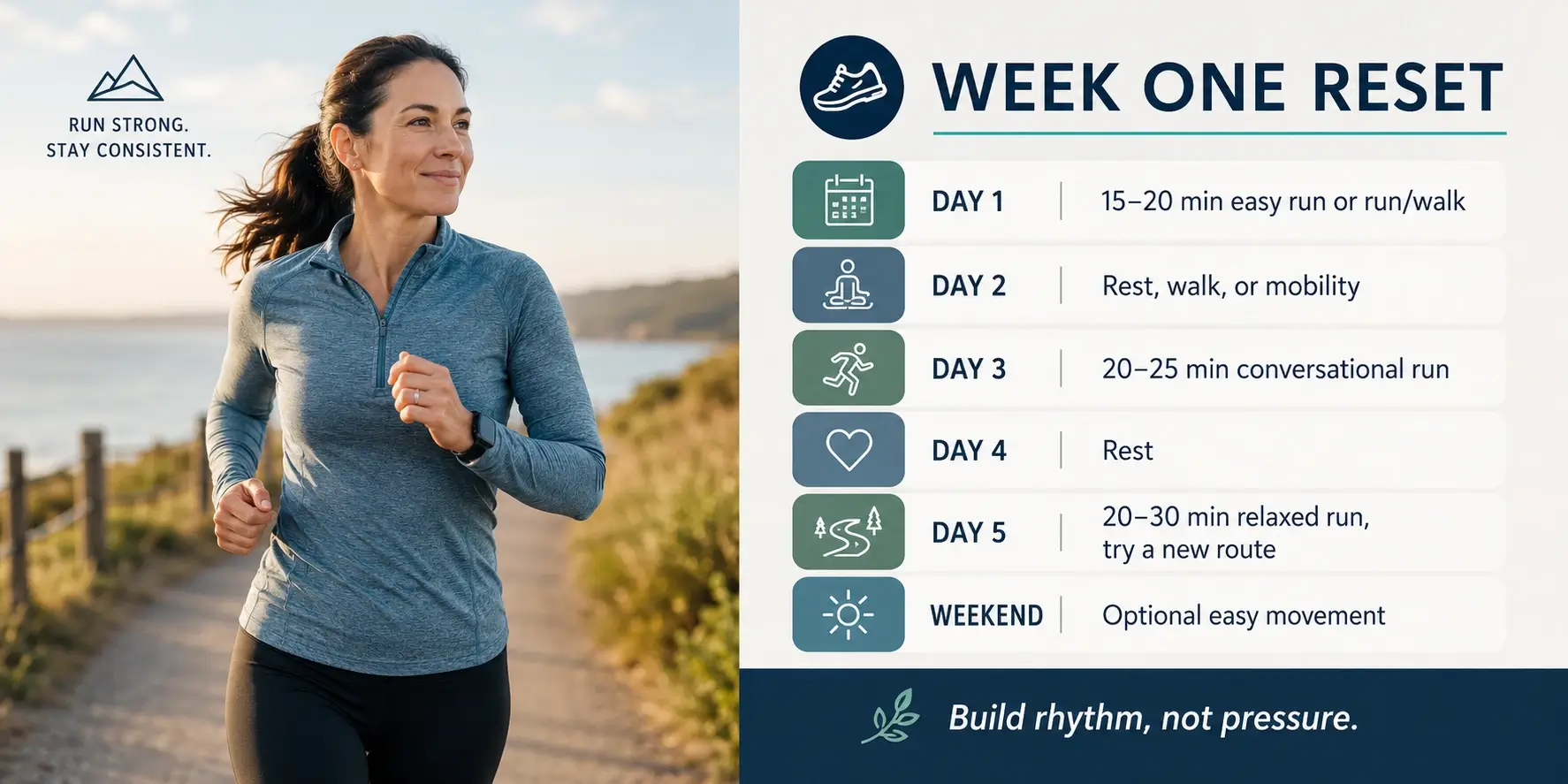
A simple comeback week could look like this:
- Day 1: 15 to 20 minutes of easy running or run/walk intervals
- Day 2: Rest, walking, or gentle mobility
- Day 3: 20 to 25 minutes at conversational effort
- Day 4: Rest
- Day 5: 20 to 30 relaxed minutes on a new route
- Weekend: Optional easy movement based on how your body feels
This is not supposed to prove that you are fit. It is supposed to remind your brain and body what regular movement feels like.
If you are returning after a much longer break, there is nothing wrong with repeating a similar week before adding more running. Progress does not have to happen every seven days.
Common Mistakes When Getting Back Into Running
The excitement of finally feeling motivated again can create another problem: doing too much.
Runners frequently derail a comeback by jumping immediately into the training they remember rather than the training they are currently prepared to handle.
Watch for these common traps:
- Returning immediately to your old weekly mileage
- Comparing every run with previous pace or race fitness
- Running easy days harder because slower paces feel uncomfortable
- Trying to make up missed workouts or mileage
- Adding speed work before basic consistency has returned
- Treating walking or shorter runs as failures
You are not starting from zero, but you are rebuilding. Give your fitness enough time to catch up with your ambition.
When Should You Start Training Seriously Again?
Eventually, you may want more than simply getting out the door. A 5K, half marathon, trail race, marathon, or another adventure can give training direction again.
Before adding serious structure, make sure running itself has become reasonably consistent.
Easy runs should feel manageable. Recovery between sessions should feel normal. You should have enough rhythm that one missed day does not make the whole week collapse.
Then you can gradually add mileage, longer runs, workouts, strength training, and race-specific preparation based on the goal in front of you.
If you are rebuilding from a longer period away, personalized online running coaching can also help remove the guesswork around how quickly to progress and how training should change as fitness returns.
Running Should Fit Your Life, Not Compete With It
Microcosm Coaching takes a human-first approach to endurance training, working with runners from beginners through marathoners, trail runners, and ultra athletes. Training is built around the whole athlete, including current fitness, goals, recovery, work, family, stress, and the realities of everyday life, with the aim of creating long-term growth rather than repeatedly pushing athletes toward burnout.
That perspective matters when you are trying to get back into running. Your comeback does not have to look like anybody else’s, including an earlier version of your own.
You are building from where you are now.
You Don’t Need to Find Your Old Momentum
It is tempting to think that getting out of a running rut means becoming the runner you were six months or two years ago.
It does not.
Maybe your schedule is different now. Maybe your goals have changed. Maybe running needs to occupy a different place in your life than it once did.
That can be a good thing.
Lower the pressure. Make running interesting again. Build a habit small enough to repeat, and let your fitness grow from consistency rather than urgency.
The first win is not running fast.
It is wanting to come back tomorrow.
Frequently Asked Questions
These questions commonly come up when runners are rebuilding consistency or trying to understand popular training approaches.
What Is the 3-3-3 Rule for Running?
There is no single universally accepted 3-3-3 rule used across running training. The phrase is sometimes used online for simplified routines involving three runs per week or other three-part training structures.
Instead of focusing on a catchy rule, returning runners are usually better served by choosing a frequency and duration they can recover from and repeat consistently.
What Is the 5-4-3-2-1 Method for Running?
The 5-4-3-2-1 method commonly describes an interval workout with running efforts that decrease in duration, such as five minutes, four minutes, three minutes, two minutes, and one minute. The shorter intervals may be performed progressively faster depending on the workout.
If you are just getting back into running after a long break, you probably do not need structured speed work immediately. Rebuild easy-running consistency first.
What Is the Best Training Plan for Getting Back Into Running?
The best plan begins with your current fitness instead of the mileage or pace you handled before your break. Start with easy runs, leave recovery between sessions, and use run/walk intervals when needed.
Once you can train consistently and recover well, gradually increase your volume and introduce more structured workouts.
What Is the 80% Rule for Running?
The 80% rule usually refers to the 80/20 approach, where roughly 80 percent of training is performed at an easy intensity and a smaller portion is performed at moderate or hard intensities.
The exact percentage does not need to become an obsession. The bigger lesson is that most endurance training should generally feel controlled rather than hard.
How Do I Get Motivated to Run Again?
Make the first run small enough that motivation is not a requirement. Commit to 10 easy minutes, choose a new route, remove pace expectations, and focus on how you feel afterward.
Motivation often follows action instead of arriving before it.
How Long Does It Take to Get Back Into Running After a Break?
There is no universal timeline. Your previous training history, length of the break, current fitness, health, recovery, and how consistently you train all influence how quickly running begins to feel familiar again.
Instead of racing the calendar, build gradually enough that you can keep showing up. Fitness tends to return much more smoothly when your comeback is sustainable.