
August 20, 2026
The Running Metrics That Matter and the Data You Can Ignore
Smartwatches give runners more data than ever. Finish a run and you might see pace, heart rate, cadence, VO2 max, training readiness, HRV, sleep score, recovery time, stress, race predictions, ground contact time, and several other numbers before you have even taken your shoes off.
More data does not automatically create better training decisions.
As coaches, we care about running metrics when they help answer useful questions. How much training are you doing? How hard is it? How is your body responding? Are you recovering? Are you becoming fitter over time?
The most useful running data provides context and reveals trends. A single watch score should rarely determine whether you train, rest, or completely change your plan.
What Running Metrics Actually Matter?
Most useful running metrics fit into three basic categories.
The first describes what you did, including time, distance, elevation, pace, and intensity. The second tells us how you responded, using heart rate, perceived effort, soreness, energy, and recovery indicators. The third helps us understand whether your fitness is improving over time.
You do not need to track every number your watch produces. For most runners, a smaller group of consistent metrics is more valuable than dozens of numbers viewed without context.
Start With Training Volume
Training volume is not exciting, but it is one of the first things we look at when evaluating an athlete’s training.
Weekly mileage, total running time, training frequency, long run duration, and elevation gain can tell us a lot about the workload an athlete is actually completing.
The important word here is trend.
A 40 mile week does not tell us much by itself. Forty miles after several consistent 35 to 40 mile weeks tells a different story than 40 miles after averaging 15 miles per week.
Consistency matters more than chasing one impressive week.
The right running frequency also depends on experience, goals, and recovery. Some athletes thrive on five or six running days, while others progress well with fewer. Understanding how many days to run each week helps put weekly mileage into a more useful context.
Pace Matters When You Compare It With Effort
Pace is one of the easiest metrics to understand and one of the easiest to misuse.
An eight minute mile on a cool, flat road is not the same physiological effort as an eight minute mile in heat, at altitude, or on a steep trail.
Instead of asking only, “How fast did I run?” ask, “How fast did I run for the effort required?”
Compare Similar Runs Over Time
One of the clearest signs of aerobic development is running faster at the same perceived effort or heart rate.
If your easy runs gradually become faster while still feeling conversational, that can indicate progress. The same applies when a familiar tempo session becomes more controlled or a repeatable hill workout requires less effort.
This relationship between pace and effort is also central to improving running economy, because becoming more efficient means producing a given pace at a lower physiological cost.
Do Not Race Your Easy Runs
Slower pace does not automatically mean lost fitness.
Heat, elevation, sleep, accumulated fatigue, stress, terrain, and the previous day’s workout can all influence pace.
Easy runs should support aerobic development and recovery. Turning every easy run into a pace test creates more noise in your data and often more fatigue in your training.
Heart Rate Is Useful With Context
Heart rate can help confirm training intensity and reveal how your body is responding to a workout.
For example, you may notice that your normal easy pace suddenly produces a much higher heart rate. That can be useful information, especially when paired with other signs of fatigue.
Heart rate is not perfectly stable, though.
Temperature, dehydration, caffeine, stress, altitude, illness, poor sleep, and sensor accuracy can all change the number.
That is why we rarely want one unexpected heart rate reading to dictate the entire training day.
Heart rate becomes more valuable when you compare it with pace, perceived effort, conditions, and recent training.
Resting Heart Rate Can Show Recovery Trends
Resting heart rate is simple, which is part of what makes it useful.
A runner who consistently measures resting heart rate under similar conditions can establish a normal range. If that number remains elevated for several mornings while sleep, soreness, or energy also worsens, the pattern deserves attention.
One unusually high reading is less meaningful.
Maybe you slept poorly. Maybe you had an unusually stressful evening. Maybe the measurement itself was inconsistent.
Look for repeated changes rather than reacting to one morning.
What HRV Can Tell Runners
Heart rate variability, or HRV, has become one of the most discussed smartwatch metrics for runners.
HRV measures variation in the time between heartbeats. It can offer information about autonomic nervous system activity and how your body may be responding to training and other stressors.
That does not mean higher is always better.
Your HRV Baseline Matters Most
HRV differs considerably between athletes.
Comparing your number with another runner’s HRV is usually not useful. What matters is understanding your own normal range and watching how it changes over time.
A runner whose HRV typically sits around one level may notice meaningful changes when it remains outside that normal pattern for several days.
Do Not Let One HRV Reading Cancel a Workout
An isolated HRV decrease should not automatically become a rest day.
If HRV is lower than usual but you slept well, feel energized, have normal resting heart rate, and are excited to train, there may be no strong reason to abandon the workout.
If HRV remains suppressed for several days and is accompanied by poor sleep, elevated resting heart rate, low motivation, and heavy legs, the combined picture is much more useful.
Data becomes powerful when metrics agree with the athlete’s experience.
Sleep Duration Matters More Than a Perfect Sleep Score
Sleep is one of the most important recovery tools available to endurance athletes.
A smartwatch can help you notice patterns in bedtime, sleep duration, and consistency. Those trends can be useful, especially during high volume training.
The watch’s exact sleep score deserves more caution.
Wearables estimate sleep using sensors and algorithms. They cannot perfectly understand what happened during your night.
If the device gives you a great score but you woke repeatedly and feel exhausted, your experience matters.
Building good sleep habits remains more valuable than chasing a perfect number. Consistent sleep for running recovery supports adaptation from the training you are already doing.
Session RPE Is One of the Best Running Metrics
Some of the most useful training data does not come from a watch.
Rate of perceived exertion, or RPE, gives runners a simple way to record how difficult a session actually felt.
A basic 1 to 10 scale works well:
- 2 to 3: Easy
- 4 to 5: Moderate
- 6 to 7: Controlled hard
- 8 to 9: Very hard
- 10: Maximum effort
The number becomes particularly useful when compared with objective data.
If you run the same route at the same pace but your RPE drops from a 5 to a 3 over several weeks, your fitness may be improving.
If your normal easy pace suddenly feels like a 7, that matters even if your watch says your training readiness is excellent.
Subjective Readiness Is Real Data
Before a workout, ask yourself a few simple questions.
How is my energy? How sore do I feel? How did I sleep? How motivated am I to train? Is anything unusually painful? How stressful has life been this week?
These answers help explain the numbers your watch cannot fully interpret.
A smartwatch does not know that you were awake with a child until 2 a.m. It does not understand a difficult week at work. It cannot fully distinguish healthy excitement from emotional exhaustion.
Your body is giving you data too.
Microcosm Coaching uses daily athlete check ins alongside objective training information because a training plan should respond to the whole person. That same human first approach shapes our online running coaching, where training is adjusted using both performance data and real life context.
Performance Trends Matter More Than Daily Scores
Ultimately, the most important metrics should help answer whether your training is working.
Look across weeks and months rather than obsessing over Tuesday morning.
Useful signs of progress include:
- Faster pace at the same effort
- Lower effort during familiar workouts
- More consistent long runs
- Better recovery between sessions
- Improved race results
- Stronger finishes late in workouts
- Greater tolerance for appropriate training volume
Those trends are usually more meaningful than whether your watch increased your VO2 max estimate from 51 to 52 overnight.
Smartwatch Metrics to Treat With Caution
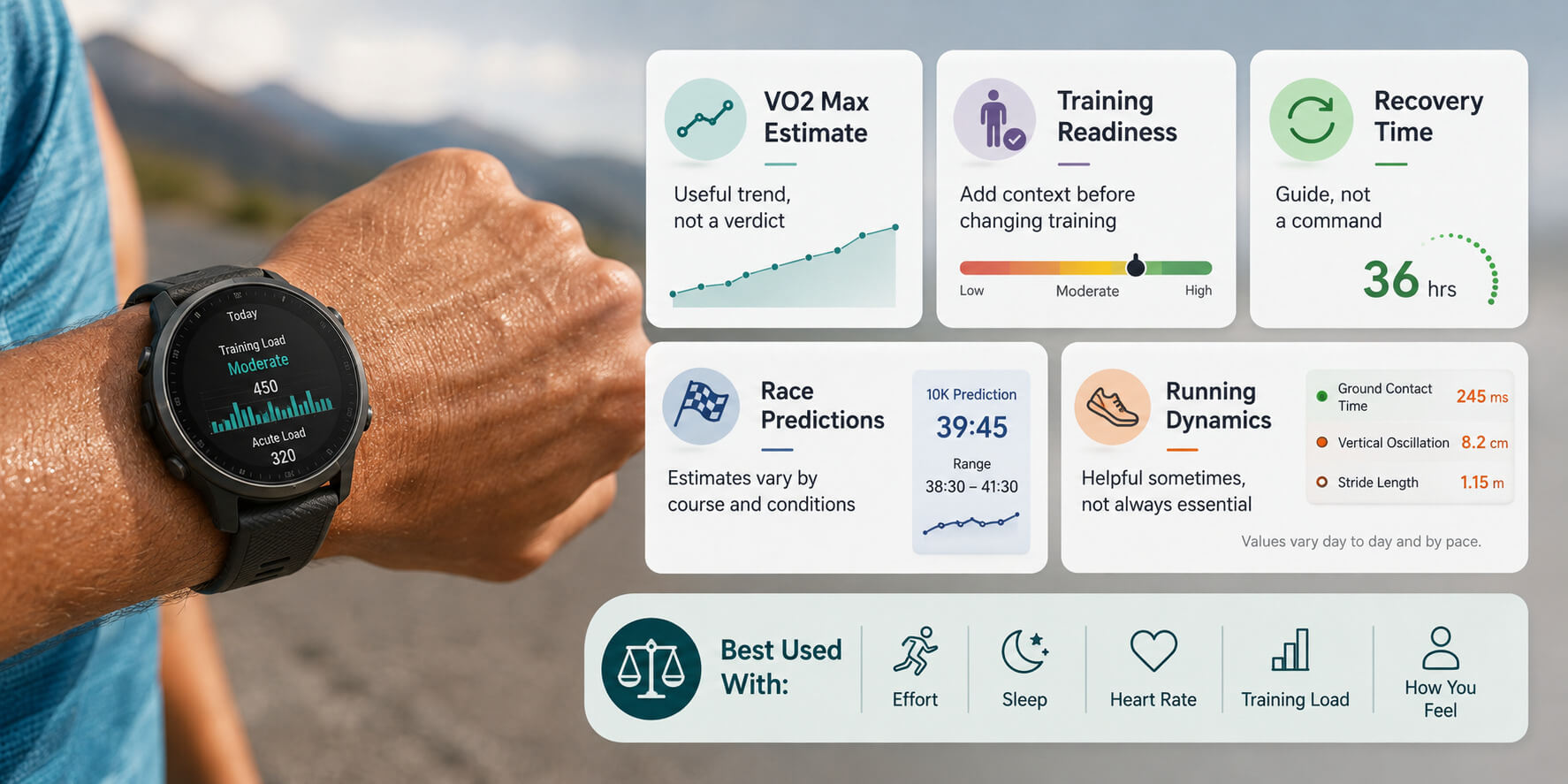
Garmin and other running watches provide several algorithm generated estimates that can be interesting without being precise enough to control training.
VO2 max estimates can show useful long term direction, but they are not the same as laboratory testing.
Training readiness and recovery time can summarize several inputs, but they should not override obvious signs from your body.
Race predictions may be motivational, but they cannot fully account for course terrain, weather, pacing, fueling, experience, or how effectively your training has prepared you for a specific event.
Running dynamics such as cadence, vertical oscillation, stride length, and ground contact time can also be useful in the right situation. Most runners do not need to optimize every metric simply because their watch displays it.
A Simple Running Data Dashboard
If all the available numbers feel overwhelming, simplify.
Track your workout duration, distance, RPE, and a short note about how you felt. Then watch weekly training volume, pace relative to effort, resting heart rate, HRV trends, sleep duration, and performance during repeatable workouts.
Metrics such as VO2 max estimates, body battery, training readiness, race predictions, and advanced running dynamics can remain optional.
The goal is not to collect the largest amount of data.
The goal is to collect enough useful information to make better decisions.
Let Data Build Awareness, Not Dependence
Your watch should help you understand yourself better over time.
As you gain experience, you should become better at connecting numbers with sensations. You begin to recognize what easy really feels like, when fatigue is normal, when something is off, and when you are ready to push.
That awareness is part of becoming a more independent athlete.
Running metrics are most powerful when they support that process rather than replacing it.
Frequently Asked Questions
What Running Metrics Should I Track?
Start with training volume, pace relative to effort, heart rate, RPE, resting heart rate, sleep duration, and performance trends. HRV can also provide useful context when viewed against your individual baseline.
What Are the Most Important Garmin Metrics for Runners?
Distance, time, pace, heart rate, and training volume are generally more actionable than many algorithm based scores. HRV and resting heart rate can also be helpful when tracked as trends.
Is HRV Important for Runners?
HRV can provide useful information about recovery and stress, but it should be interpreted relative to your own baseline and combined with sleep, resting heart rate, perceived fatigue, and training context.
Should I Train if My HRV Is Low?
One low HRV reading does not automatically require rest. Look at the trend and consider how you feel, your resting heart rate, sleep quality, soreness, and recent training.
Is Garmin VO2 Max Accurate?
A smartwatch VO2 max estimate can be useful for tracking general trends, but it should not be treated as an exact laboratory measurement.
Is Pace or Heart Rate More Important?
Neither should always dominate. Pace tells you what you produced, while heart rate helps describe the physiological cost. Perceived effort and training conditions provide additional context.
Which Running Metrics Can I Ignore?
You do not need to obsess over daily VO2 max changes, one night of HRV, exact race predictions, small cadence fluctuations, recovery countdowns, or training status labels unless they provide meaningful context for your goals.
How Do I Know if My Running Fitness Is Improving?
Look for faster running at the same effort, improved execution of familiar workouts, stronger long runs, better recovery, greater training consistency, and improved race performance.