
May 5, 2026
Altitude Training: Strategies for Running High Above Sea Level
Altitude changes everything.
Your breathing. Your pace. Your sleep. Your recovery.
And if you treat altitude like sea level, you usually pay for it fast.
This guide is a practical playbook for runners who are training or racing high above sea level. It covers what to expect, how to acclimate, how to adjust training, and what to do if you can’t get to altitude until race week.
What Altitude Does to Your Body
At altitude, there’s less available oxygen in each breath. That means the same pace costs more effort. Heart rate tends to drift higher. Breathing feels harder. And workouts that feel “normal” at sea level can suddenly feel like a struggle.
In the first few days, many athletes feel flat or heavy. Sleep can be disrupted. Appetite can change. And you may notice you’re more sensitive to dehydration.
Over time, your body begins adapting. You become more efficient at using oxygen. You can tolerate effort better. And for some athletes, longer stays at altitude support improved oxygen delivery when they return to lower elevations.
The biggest mistake runners make is trying to prove fitness in the first week. Altitude rewards patience, not ego.
The Three Main Altitude Training Approaches
There are three common ways athletes use altitude for performance or race prep. The “best” one depends on your goals and logistics.
Live High, Train Low (LHTL)
This is widely considered the gold standard when performance is the priority. The idea is simple: you sleep and spend lots of time at altitude, but you do your key workouts at lower elevation so you can keep intensity and speed higher.
This approach is great when you’re trying to gain the benefits of living high while still getting high-quality sessions. It’s not always easy to execute, but when it’s possible, it can be a strong strategy.
Live High, Train High (LHTH)
This is the most common real-world approach because it’s simple: you go to altitude, and you do everything there.
It’s especially useful if your goal race is at altitude, because you’re practicing the exact environment you’ll race in. The tradeoff is that your absolute intensity often needs to drop. Your pace will slow. Hard workouts can feel harder. And recovery usually needs more attention.
If you choose this approach, the goal is not to “match sea-level paces.” The goal is to train by effort, stay consistent, and arrive healthy.
Simulated Altitude (When Travel Isn’t Possible)
Some athletes explore altitude tents or hypoxic systems to simulate lower-oxygen environments. These tools can be part of an altitude strategy, but they’re not magic. They require consistency, careful planning, and realistic expectations.
If you consider simulated altitude, think of it as a supplement to smart training, not a substitute for it. The fundamentals still matter most: aerobic development, appropriate intensity, and recovery.
Acclimatization Timeline: What to Do by Day
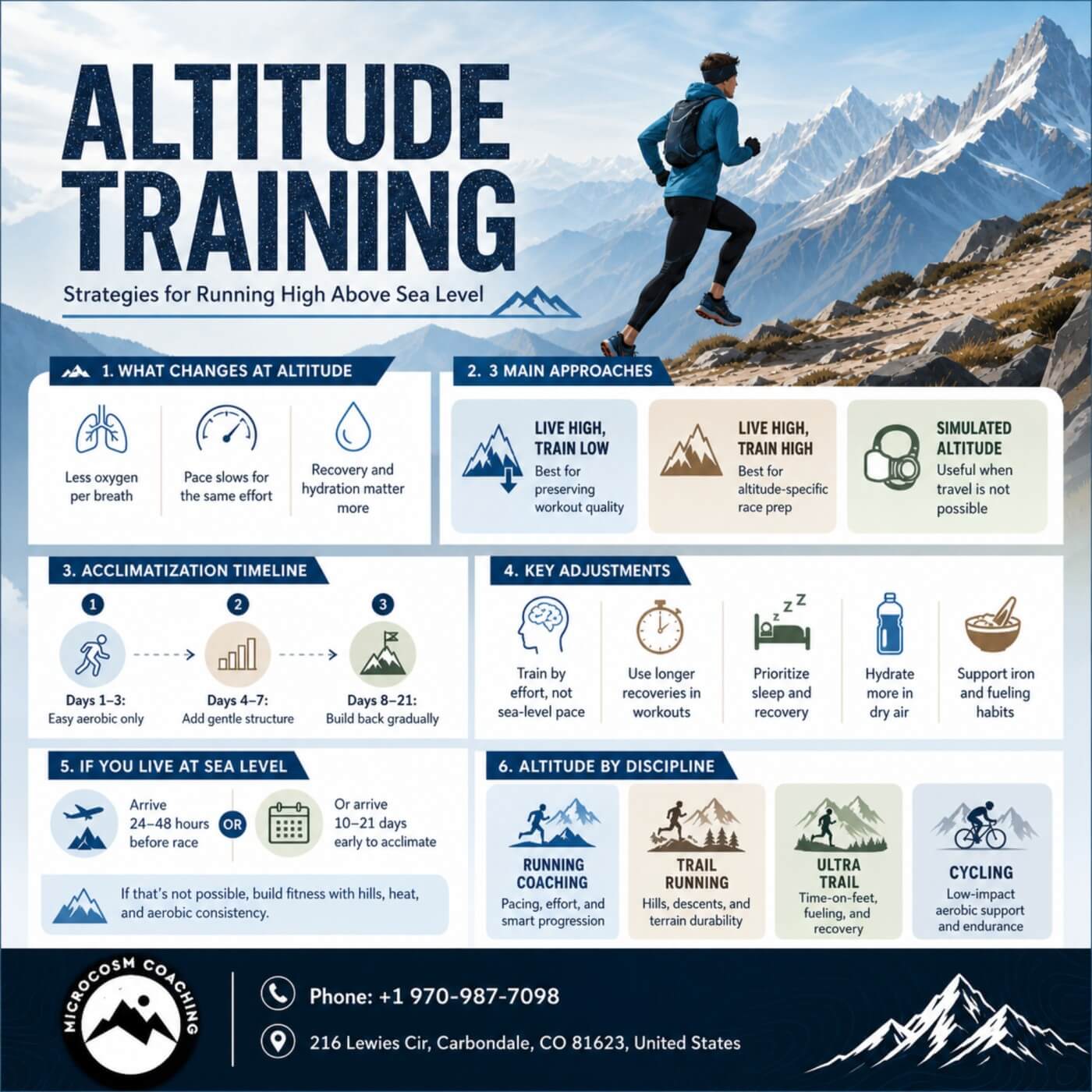
Altitude adaptation isn’t instant. The body needs time. Here’s a simple framework that works for most runners.
Days 1–3: Keep It Easy
This is the “don’t be a hero” phase. Your job is to arrive, settle, and reduce stress.
Do only light aerobic work. Keep sessions short. Walk breaks are fine. If you feel breathless at easy effort, slow down even more.
Prioritize sleep and hydration. If you have a hard workout planned, move it.
Days 4–7: Add Gentle Structure
Once the initial shock settles, you can add a little structure without forcing it.
Short strides or gentle pickups can help your legs feel snappy without draining you. Easy hill hiking or controlled uphill efforts can be useful. But keep the overall week conservative.
Many athletes feel “better” on days 4–7 and then overdo it. Don’t. Build slowly.
Days 8–21: Gradual Return to Normal Patterns
If you’re staying longer, your body begins settling into altitude training. You can gradually bring back more normal training rhythms. Even then, you’ll likely need more recovery than usual.
Think: steady progression, not sudden intensity jumps. Altitude amplifies training stress, so small changes matter.
Pace Adjustments That Keep You Out of Trouble
The most important altitude skill is learning to detach from pace.
At altitude, effort is the truth. Pace is just a number that changes with oxygen availability, terrain, heat, wind, and fatigue. If you chase sea-level paces, you’ll usually spike stress, compromise recovery, and derail the week.
Use effort and breathing as your guide. If “easy” doesn’t feel easy, make it easier. If you can’t speak in short phrases on an easy run, you’re going too hard.
For workouts, build in longer recoveries than you would at sea level. Interval sessions often require more rest between efforts. You’re not getting weaker—you’re training in thinner air.
A helpful mindset: altitude is a different sport for a few days. Treat it that way.
Recovery Rules at Altitude
Altitude adds invisible stress. Even when training looks light on paper, your body may be working harder behind the scenes.
Sleep is often disrupted early on. If your sleep dips, you may need to cut volume or add recovery days. If you feel unusually sore or flat, listen.
Strength training should also be adjusted in the first week. Keep it lighter, focus on movement quality, and avoid digging a deep fatigue hole while your body is adapting.
Nutrition matters too. Appetite changes are common, but fueling is non-negotiable. Altitude training can increase energy demand, and under-fueling makes acclimatization harder.
If you can do one thing well at altitude, do this: recover like it’s your job.
Iron, Hydration, and Fueling: The High-Leverage Basics
Iron (And Why It Matters)
Altitude adaptation can increase the demand for iron, because iron supports oxygen transport in the body. If your iron stores are low, adaptation may be limited and fatigue can rise.
Before making changes, it’s smart to discuss iron status with a medical professional. Don’t guess. If you’re concerned, get guidance, especially before supplementing.
From a practical standpoint, focus on iron-rich foods, consistent fueling, and pairing iron foods with vitamin C-rich foods to support absorption. Avoid taking iron alongside calcium-rich foods if you’re supplementing under guidance.
Hydration
Altitude air is often dry, and you can lose fluid faster through breathing and sweat. Many runners underestimate this.
Drink consistently throughout the day, not just around runs. If urine is consistently dark, that’s a signal to adjust. Electrolytes can help, especially if you’re sweating heavily.
Fueling
At altitude, carbohydrates become especially important for higher-intensity work. Appetite can drop, but your body still needs fuel. Keep things simple: fuel early, fuel often, and don’t wait until you’re depleted.
If you’re racing at altitude, use training to practice race-day fueling under altitude stress. That’s one of the most valuable prep tools you have.
If You Live at Sea Level and Race at Altitude
This is a common situation. You live low, but your race is high.
There are two classic strategies:
Arrive very close to race day.
Some athletes arrive 24–48 hours before racing to compete before the full altitude stress builds. This can work for some people, especially if logistics don’t allow a longer stay.
Arrive early enough to truly acclimate.
If you can arrive 10–21 days early, you give your body time to settle and adapt more fully. This approach tends to reduce the “shock” and can make pacing more predictable.
If you only have 5–7 days, don’t panic. Keep the first days easy, focus on hydration and sleep, and accept that pacing will be effort-based. Your job is not to force fitness. Your job is to arrive as fresh as possible.
Sea-Level Alternatives That Can Help
Not everyone can travel to altitude before a race. If you’re staying at sea level, there are still ways to prepare for “thin air” demands.
Heat training is one option some athletes use to support endurance adaptations like plasma volume, but it must be done safely and gradually. Breathing exercises or inspiratory muscle work can support respiratory strength for some athletes, but they’re not a replacement for aerobic development.
The most reliable approach is still the boring one: build a strong aerobic base, add controlled intensity, and stay consistent. Fitness always translates.
How This Changes by Sport
Running Coaching
Altitude training is where coaching becomes extremely valuable. A coach helps you adjust intensity, protect recovery, and avoid the classic mistakes of doing too much too soon. Training becomes effort-based, and your plan needs to adapt to fatigue patterns and sleep changes. Coaching helps keep your training sustainable and purposeful instead of reactive.
Trail Running Coaching
Trail athletes often face altitude plus terrain stress. Long climbs, technical descents, and uneven footing amplify fatigue. At altitude, downhill muscle damage can take longer to recover from, and uphill pacing needs to be conservative. A good trail plan uses effort-based targets, strategic hiking, and extra recovery so you build durability without getting wrecked.
Ultra Trail Running Coaching
Ultra training at altitude requires patience and a long timeline. Time-on-feet sessions may need to be shorter or easier early on, fueling practice becomes even more important, and recovery must be prioritized. The goal is not to “win workouts.” It’s to build consistent weeks that strengthen your endurance engine and mental steadiness under stress.
Cycling Coaching
Cycling at altitude often means power targets shift and recoveries need to increase. The bike can also be a smart way to add low-impact aerobic volume when running stress is high. Structured rides, careful intensity control, and hydration strategy become key. Cycling is a powerful tool for maintaining endurance while protecting your legs.
How Microcosm Coaching Works
Microcosm Coaching is a human-first endurance coaching organization that helps athletes train with mastery, joy, and long-term sustainability. We coach runners, trail and ultra athletes, skimo athletes, and cyclists through personalized plans and a consistent feedback loop that adapts as life happens. If you want support with altitude prep, you can explore our Running Coaching for road and marathon goals, work with a Trail Running Coach for terrain and vert-specific planning, or use Cycling Coaching to build a stronger aerobic engine with lower impact. Each option is built on the same foundation: evidence-based training, stress-aware adjustments, and a coaching relationship that supports you through the full process.
Final Thoughts
Altitude training isn’t about proving toughness.
It’s about being patient enough to let your body adapt.
If you keep the first days easy, detach from pace, fuel well, hydrate consistently, and protect recovery, altitude can become a powerful training environment.
Train smart. Stay consistent. And let the mountain do its work.
FAQs
What’s the best altitude for altitude training?
Many athletes target moderate altitude where adaptation can happen while training remains manageable. The sweet spot depends on goals and how well you tolerate altitude.
How long does it take to acclimate to altitude?
Most runners feel the first 3–5 days strongly. Many feel more settled within 7–14 days. Full acclimation can take longer, depending on the person and altitude level.
How much slower will I run at altitude?
It varies widely, but most runners notice pace slows for the same effort. The key is to train by effort and breathing, not by sea-level pace.
Is live high, train low better than live high, train high?
Live high, train low is often preferred for performance because it preserves workout quality. Live high, train high is very practical and can be ideal for altitude-specific race prep.
Should I change my workouts at altitude?
Yes. Most athletes need reduced intensity, longer recoveries, and more conservative volume in the first week.
Do I need to take iron for altitude training?
Don’t guess. If you’re concerned, discuss iron status with a clinician. Food-first habits and professional guidance are best.
Can I prepare for altitude without going to altitude?
You can’t fully replicate altitude, but you can build a strong aerobic base, use conservative pacing, and prepare with smart heat or breathing strategies if appropriate.
What is the 80% rule in running, and does it change at altitude?
The idea is that most training should be easy, with a smaller portion hard. At altitude, that principle becomes even more important because intensity costs more and recovery is slower.