
June 20, 2026
Tempo Run Vs Threshold Run: How To Train LT And AT Without Guessing
Tempo run, threshold run, lactate threshold, aerobic threshold, anaerobic threshold, comfortably hard, hard but controlled. If you have ever looked at a training plan and wondered whether all of these terms mean the same thing, you are not alone.
Runners often use “tempo” and “threshold” interchangeably, but they are not always the same workout. They can overlap, and different coaches may define them slightly differently, but the purpose behind each session matters more than the label.
The goal is not to memorize perfect terminology. The goal is to understand what your body is being asked to do, how hard the workout should feel, and how to avoid turning every moderate run into a race.
Tempo Run Vs Threshold Run: The Simple Difference
A tempo run is usually a sustained, controlled effort that improves stamina and aerobic efficiency. It should feel comfortably hard, but not desperate. You are working, breathing is elevated, and focus is required, but you are not fighting to survive the workout.
A threshold run is more precise. It is usually run near your lactate threshold, the point where your body is producing and clearing lactate at a high but manageable rate. These workouts often use intervals, sometimes called cruise intervals, so you can accumulate more quality time without tipping too far into fatigue.
In simple terms, tempo builds your ability to hold a strong rhythm. Threshold builds your ability to hold a faster rhythm before fatigue rises quickly.
What LT And AT Actually Mean
Before choosing paces, it helps to understand the two major thresholds runners talk about. You do not need a lab test to train well, but you do need a practical sense of what these zones feel like.
These concepts are especially useful for runners training for longer races, where pacing and effort control matter as much as fitness.
Aerobic Threshold
Aerobic threshold, often called AT or LT1, is the point where your effort rises above easy running but remains very sustainable. You are still mostly aerobic, meaning your body can keep producing energy efficiently for a long time.
Training around aerobic threshold helps improve endurance, stamina, fat metabolism, and the ability to run faster without feeling like you are pushing hard. This is why tempo running can be so valuable for marathoners, ultra runners, and busy athletes who need durable fitness.
A true aerobic threshold effort should not leave you wrecked. You should finish feeling like you worked, but also like you could train again soon.
Lactate Threshold
Lactate threshold, often called LT or LT2, is a harder effort. This is the zone where lactate production rises, but your body is still able to clear it well enough to keep going for a meaningful amount of time.
For many trained runners, this effort is somewhere around one-hour race effort. For some runners, it may sit near 10K pace. For others, especially highly trained athletes, it may be closer to 15K or half-marathon effort.
This is why guessing from a pace chart can be risky. Threshold is not just a number. It is a physiological effort that shifts as your fitness, fatigue, weather, terrain, and training history change.
Anaerobic Threshold
Anaerobic threshold is often used to describe the upper threshold where running starts to feel much harder and fatigue builds more quickly. In many running conversations, anaerobic threshold and lactate threshold are used in similar ways.
The important thing is not arguing over the exact term. The important thing is knowing whether your workout is meant to be controlled stamina, true threshold work, or a higher-intensity interval session.
Why Runners Get Tempo And Threshold Wrong
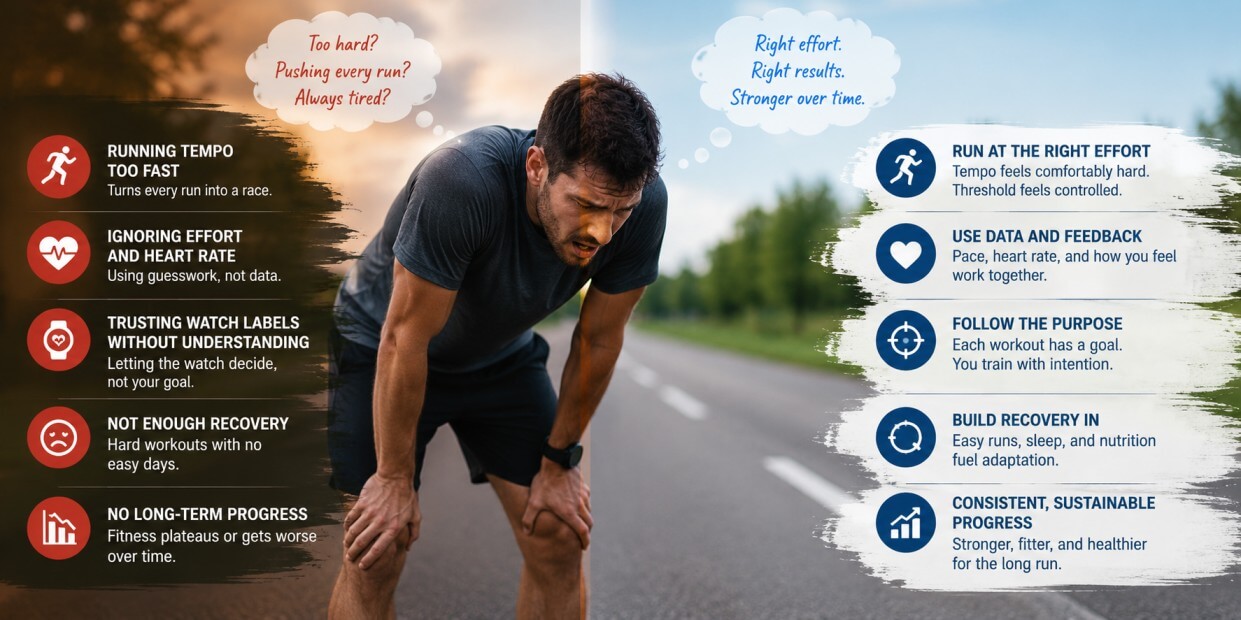
Most runners do not fail tempo and threshold workouts because they are lazy. They miss the target because the effort is easy to overcook.
“Comfortably hard” sounds simple, but when you feel good, it is tempting to press. A tempo run becomes a race. A threshold interval becomes a VO2 max rep. Then the next easy run feels heavy, the long run suffers, and the cycle repeats.
This is the gray zone problem. You are not running easy enough to recover, but you are not training specifically enough to get the full benefit of hard workouts.
The most common mistakes include:
- Running tempo pace too close to 10K effort
- Starting threshold intervals too fast
- Trusting wrist heart rate without context
- Using Garmin labels without understanding the workout goal
- Racing the final rep to “prove fitness”
- Doing threshold work too often without enough recovery
A good workout should build confidence. It should not create a weekly test you feel pressured to pass.
How To Find Your Tempo Pace Without Guessing
Tempo pace should feel strong, smooth, and repeatable. For many runners, it falls somewhere around marathon to half-marathon effort, depending on the workout length and the athlete’s fitness.
A shorter tempo may drift closer to half-marathon effort. A longer tempo, especially for marathoners and ultra runners, may sit closer to marathon effort or slightly faster than steady-state running.
A practical way to check tempo effort is the talk test. During a tempo run, you should be able to speak in short phrases, but not hold a relaxed conversation. Something like “I’m doing okay” should be possible, but you would not want to explain your weekend plans.
If you are using pace, recent race results are more useful than goal pace. Your current fitness should guide the session, not the version of yourself you hope to become in twelve weeks.
For athletes building toward longer races, tempo work fits naturally into a broader online marathon coaching plan because it teaches rhythm, patience, and effort control over time.
How To Find Your Threshold Pace Without Guessing
Threshold pace should feel hard, controlled, and focused. You should not feel relaxed, but you should also not feel like you are hanging on for dear life.
For many runners, threshold sits around 10K to one-hour race effort. That range matters because a newer runner’s one-hour pace may be very different from their 10K pace, while a more experienced runner may hold a faster pace for longer.
A good threshold workout usually feels manageable early and demanding late. If the first rep already feels like a race, you are probably too fast.
Heart rate can help, especially if you know your lactate threshold heart rate. Still, heart rate lags behind effort, so the first few minutes of an interval may not show the full picture. Heat, dehydration, stress, poor sleep, and fatigue can also raise heart rate.
This is where daily reflection matters. A watch can give data, but your body gives context.
Tempo Run Examples
Tempo workouts should be simple enough to execute well. The goal is rhythm, not heroics.
A beginner runner might start with:
10 to 15 minutes easy
15 to 20 minutes at controlled tempo effort
10 minutes easy
An intermediate runner might try:
15 minutes easy
25 to 35 minutes at tempo effort
10 minutes easy
A marathon-focused runner might use:
15 minutes easy
2 x 20 minutes at steady tempo effort with 3 minutes easy jog
10 minutes easy
The pace should be controlled from the beginning. If you are closing much faster than you started, the workout may have become a progression run instead of a tempo session.
That is not always bad, but it should be intentional.
Threshold Run Examples
Threshold workouts are often best broken into intervals. This helps you stay near the right intensity without turning the session into a long grind.
One classic example is:
15 minutes easy
3 x 10 minutes at threshold with 60 to 90 seconds easy jog
10 minutes easy
Another good option is:
15 minutes easy
5 x 5 minutes at threshold with 60 seconds easy
10 minutes easy
For more experienced runners:
20 minutes easy
4 x 8 minutes at threshold with 90 seconds easy jog
10 to 15 minutes easy
The rest should be short enough to keep the workout connected, but long enough to help you reset your breathing and form. You are not trying to fully recover like you might during VO2 max intervals.
You are trying to stay smooth under pressure.
Tempo Vs Threshold Vs VO2 Max
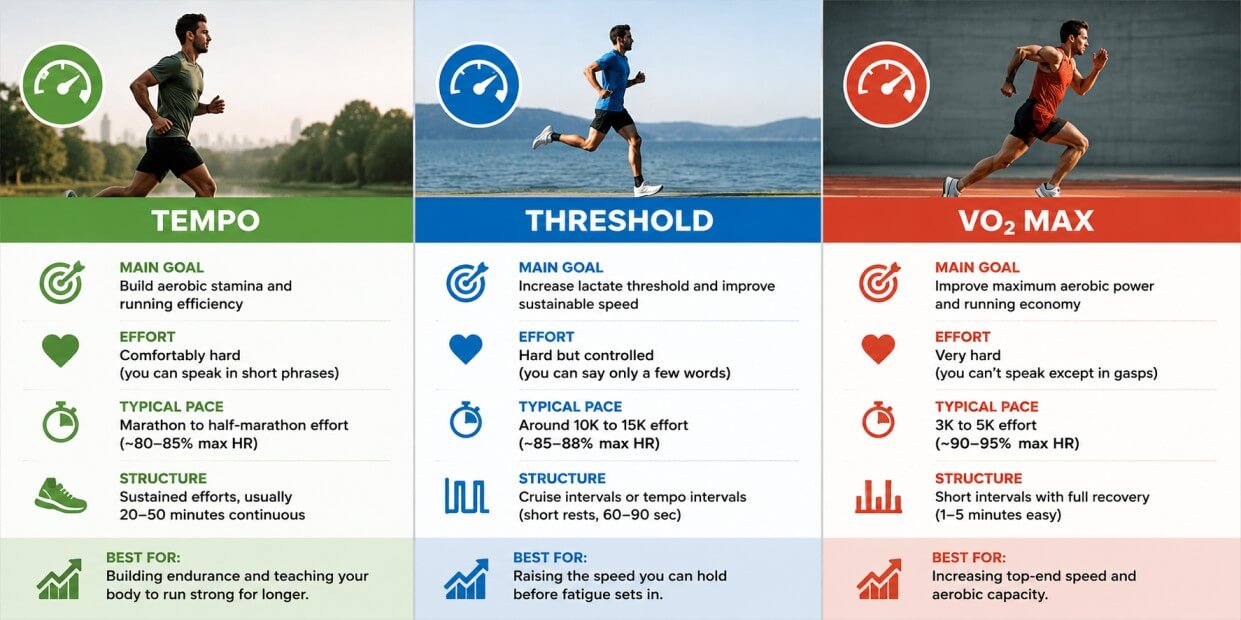
Tempo, threshold, and VO2 max workouts all improve fitness, but they are not interchangeable.
Tempo runs build stamina and aerobic durability. They teach you to run strong without constantly pushing into high fatigue.
Threshold runs improve the speed you can sustain before fatigue rises sharply. They are great for 10K, half marathon, marathon, trail racing, and ultra running when used correctly.
VO2 max workouts are shorter and harder. These intervals often feel closer to 3K to 5K effort and require more recovery. They build top-end aerobic power, but they are not the same as threshold work.
A runner who turns every threshold session into VO2 max work may feel fit for a few weeks, then flat, sore, or mentally burned out.
The right question is not, “Which workout is best?” The better question is, “What adaptation am I trying to create today?”
How To Use Your Watch Without Letting It Coach Your Ego
GPS watches are useful, but they are not magic. Pace alerts, heart rate zones, workout screens, and post-run labels can help you train smarter, but only if you understand the purpose of the session.
For tempo runs, set a pace range that stops you from starting too fast. The upper limit matters because the biggest mistake is usually overreaching early.
For threshold intervals, use a realistic pace range based on current fitness. If your recent 10K pace is 7:30 per mile, do not set your threshold workout at 7:00 pace just because that is your goal race pace.
You can also use lap pace instead of instant pace. Instant pace jumps around too much, especially under trees, around buildings, or on rolling terrain. Lap pace gives a steadier picture.
After the workout, look beyond average pace. Ask better questions:
Did I stay controlled?
Did my heart rate drift too much?
Could I repeat this workout next week?
Did my easy runs recover normally afterward?
Training without guessing does not mean ignoring feel. It means combining data, effort, and coach feedback into a smarter decision.
Where Tempo And Threshold Fit In A Training Week
Most runners do not need multiple threshold sessions every week. One quality tempo or threshold workout, combined with easy running, long runs, strides, and strength or mobility work, is often enough to make progress.
The exact structure depends on the athlete. A marathoner may use longer tempo work. A 10K runner may need more threshold and VO2 max development. A trail runner may use threshold intervals on rolling terrain to practice effort control. An ultra runner may use steady aerobic work to build durability without adding unnecessary strain.
This is why copying workouts from another runner can backfire. The workout may be good, but it may not be right for your current phase, fatigue level, race goals, or life stress.
If you are building toward a longer race, your timeline matters too. A smart training plan should leave enough space for base building, workout progression, long runs, tapering, and recovery. That is why understanding how long it takes to train for a marathon can help you place harder workouts in the right season instead of rushing fitness.
The Microcosm Coaching Perspective
At Microcosm Coaching, training is built for humans, not just athletes. The goal is not to chase intensity for its own sake, but to use evidence-based workouts in a way that supports long-term growth, confidence, health, and joy in the process.
That means most training is still low intensity, while workouts like tempo runs, threshold intervals, strides, and race-specific sessions are placed with purpose. Through daily check-ins, coach feedback, and flexible adjustments, athletes can understand not just what they are doing, but why they are doing it. That is the heart of a human-first run coaching philosophy that supports sustainable progress over months and years.
Signs You Are Running Too Hard
The simplest sign that a tempo or threshold workout is too hard is that it stops being repeatable. You may finish the workout, but the cost is too high.
If you need several days to feel normal again, your threshold session may have become a race. If your easy runs keep getting slower or your legs feel flat every week, the intensity may be stealing from your consistency.
Other signs include poor sleep after workouts, unusual soreness, irritability, heavy legs during warmups, and a growing sense of dread before quality days.
Hard workouts should require focus. They should not make you feel like you are constantly proving your worth as a runner.
How Often Should You Run Tempo Or Threshold?
For many runners, one tempo or threshold session per week is plenty. Some weeks may include a lighter workout, such as strides or short hills, while other weeks may include a longer race-specific session.
More advanced runners may include both tempo and threshold work in a training cycle, but that does not mean both need to happen every week. The body adapts when stress and recovery are balanced.
If life is especially stressful, sleep is poor, or your easy running is not recovering, it may be smarter to shorten the workout, slow the pace, or replace the session with an easier aerobic run.
A flexible plan is not a weak plan. It is often the reason athletes stay healthy long enough to reach the next level.
Race-Specific Examples
For a 5K or 10K runner, threshold work can help bridge the gap between easy mileage and faster interval sessions. It builds the ability to stay composed when the pace gets uncomfortable.
For a half marathoner, tempo and threshold work are central. The race itself lives close to these efforts, so practicing rhythm, fueling, pacing, and patience becomes especially important.
For a marathoner, tempo work often teaches control. It helps you run faster without burning through energy too early. Threshold work can still be useful, but it must support the bigger goal rather than drain the legs.
For trail and ultra runners, these workouts may be based more on effort than pace. Hills, terrain, altitude, and technical footing can make pace misleading. In that case, heart rate, breathing, and perceived effort become more useful than a strict pace target.
For athletes preparing for Boston, controlled effort matters even more because the course rewards patience, pacing, and preparation. A personalized Boston Marathon coach can help place tempo and threshold work into a plan that prepares the body for both the early downhills and the later climbs.
Final Takeaway: Train With Purpose, Not Panic
Tempo runs and threshold runs are both powerful tools, but they work best when you know why they are in your plan.
Tempo runs build strong, sustainable rhythm. Threshold runs improve the speed you can hold before fatigue rises quickly. VO2 max workouts develop a different kind of high-end aerobic power.
You do not need to guess every workout. Use recent fitness, effort, heart rate, pace, terrain, and recovery to guide the session. Start controlled. Stay honest. Finish with the feeling that you trained, not that you raced.
The best runners are not the ones who force every workout to be harder. They are the ones who learn the purpose of the work, execute it with patience, and stack small, smart decisions over time.
FAQs
What Is The Difference Between A Tempo Run And A Threshold Run?
A tempo run is usually a sustained, comfortably hard effort that builds stamina and aerobic efficiency. A threshold run is typically closer to lactate threshold and is often broken into intervals so you can spend more time at a harder but controlled intensity.
Is A Tempo Run The Same As A Threshold Run?
Not always. Some coaches use the terms interchangeably, but tempo often refers to a slightly more controlled aerobic stamina effort, while threshold usually targets lactate threshold more precisely.
What Pace Should A Threshold Run Be?
Threshold pace is often around 10K to one-hour race effort, depending on the runner. It should feel hard but sustainable, not like an all-out interval or race effort.
Is Threshold Pace 10K Pace Or Half Marathon Pace?
It depends on your fitness level and race times. For some runners, threshold may be close to 10K pace. For others, it may be closer to 15K or half-marathon effort. Current fitness is more useful than a fixed rule.
How Do I Set Tempo And Threshold Zones On Garmin?
Use recent race data, heart rate trends, and realistic pace ranges. For tempo runs, set a range that keeps you from starting too fast. For threshold workouts, use a controlled range based on current fitness rather than goal pace.
What Is Better: Tempo, Threshold, Or VO2 Max Training?
None is automatically better. Tempo builds stamina, threshold improves sustainable speed, and VO2 max develops top-end aerobic power. The best choice depends on your race goal, training phase, and recovery.
How Often Should I Do Threshold Runs?
Most runners do well with one threshold or tempo-style workout per week. More experienced runners may use threshold work more often in certain phases, but only when recovery, easy mileage, and overall stress are managed well.
What Is A Good Threshold Run Example?
A classic threshold workout is 3 x 10 minutes at threshold effort with 60 to 90 seconds of easy jogging between reps. It should feel controlled early and challenging by the final rep, but never like an all-out race.