
June 20, 2026
Race Strategy For Runners: How To Plan And Execute From 800m To 10K
Fitness matters, but fitness alone does not guarantee a great race. Whether you’re lining up for an 800m, a mile, a 5K, or a 10K, your ability to execute a smart race plan can be the difference between achieving your goal and wondering what went wrong.
Many runners spend months building fitness only to sabotage their race with an overly aggressive start, poor pacing decisions, or a lack of preparation for the inevitable discomfort that comes with racing. The good news? Race strategy is a skill, and like any skill, it can be developed.
At Microcosm Coaching, we believe that great racing isn’t about suffering more than everyone else. It’s about developing awareness, making smart decisions under pressure, and learning from each experience so you continue improving over time.
Why Race Strategy Matters
Most runners think of race performance as a reflection of fitness. While fitness is certainly important, race execution often determines whether you actually realize your fitness on race day.
A strong race strategy helps you:
- Manage energy effectively
- Avoid early mistakes
- Stay mentally engaged
- Respond to changing conditions
- Finish stronger than your competitors
The best racers are not always the fittest athletes. Often, they’re the athletes who understand how to distribute their effort across the entire race.
Start With Your Goal
Before developing a race plan, it’s important to understand what success looks like for that specific event.
Some races are about chasing a personal best. Others are about gaining experience, building confidence, testing fitness, or competing for placement.
Your strategy should reflect your objective.
If your goal is a personal record, pacing becomes critical. If your goal is competing for position, you may need to respond to race dynamics instead of focusing solely on splits. If you’re building confidence after injury or time away from racing, success may simply mean executing a controlled effort from start to finish.
Having a clear purpose gives every decision on race day more direction.
The Universal Rules Of Smart Racing

Regardless of distance, a few principles apply to nearly every successful race.
Never Bank Time
One of the most common mistakes runners make is trying to create a cushion by running faster than goal pace early.
Unfortunately, the body doesn’t work that way.
The energy you spend in the first part of the race is often paid back with interest later. A few seconds gained early can easily become minutes lost late.
Instead of banking time, focus on running the pace or effort that your fitness supports.
Run The Shortest Course Possible
Every extra step requires energy.
Whether you’re racing on the track or roads, pay attention to your positioning. Running wide around turns, weaving through crowds, or drifting unnecessarily can add significant distance by the finish line.
Small details matter when you’re trying to maximize performance.
Race By Effort When Conditions Change
Not every race day provides perfect conditions.
Heat, humidity, wind, hills, altitude, and crowded courses can all impact pace. On challenging days, successful runners focus on maintaining effort rather than obsessing over exact splits.
Your watch provides useful information, but your body provides context.
800m Race Strategy: The Controlled Burn
The 800m is often viewed as a sprint, but the best performances require a combination of speed, aerobic fitness, and composure.
The First 200m
The goal is to establish position without sprinting at maximum effort.
You want to accelerate efficiently and settle into your race rhythm as quickly as possible. Going out too hard can make the final lap feel significantly longer.
The Middle Section
Between 200m and 600m, focus on staying relaxed.
Many runners tighten their shoulders, overstride, or waste energy fighting the discomfort that naturally develops. Relaxed arms, efficient turnover, and controlled breathing become increasingly important.
The Final 200m
This is where the race becomes a test of commitment.
The athlete who can maintain form and continue pressing forward when fatigue arrives often gains the biggest advantage. Focus on quick turnover, strong posture, and using every remaining ounce of energy.
Mile And 1500m Race Strategy: Patience Wins
The mile and 1500m occupy a unique place in racing. They are short enough to require aggression but long enough to punish impatience.
The runners who execute these races best are often the athletes who remain patient during the opening half.
Stay Controlled Early
The first lap should feel smooth and manageable.
Many athletes get caught up in the excitement of the start and find themselves running faster than planned. If you’re breathing heavily during the opening stages, there’s a good chance you’re spending energy you’ll need later.
Stay Connected In The Middle
The middle portion of the race requires focus.
Stay engaged with the athletes around you, maintain rhythm, and avoid mentally checking out when the pace feels uncomfortable. This is often where races begin to separate.
Build Into The Finish
Instead of waiting until the final straightaway, begin increasing effort before the last lap concludes.
A gradual acceleration often produces better results than a sudden sprint attempt after waiting too long.
5K Race Strategy: Controlled Start, Brave Middle
The 5K is one of the most challenging races to execute properly because it feels deceptively manageable during the early stages.
Many runners sabotage their race in the first kilometer.
Start Slightly Conservative
The opening minute of a 5K often feels easy.
That feeling is misleading.
Allow yourself to settle into the race before fully committing to goal pace. Starting just slightly controlled helps preserve energy for the critical middle section.
Stay Focused Through The Middle
The middle kilometers often determine the outcome of the race.
This is where discomfort becomes unavoidable. Rather than focusing on how far remains, concentrate on maintaining rhythm, posture, and effort.
Break the race into smaller segments and focus on reaching the next landmark.
Compete In The Final Kilometer
Once you’re approaching the final kilometer, it becomes time to race rather than pace.
Identify runners ahead and gradually reel them in. Having specific targets can make it easier to push through fatigue and maintain focus.
10K Race Strategy: Patience Before Pressure
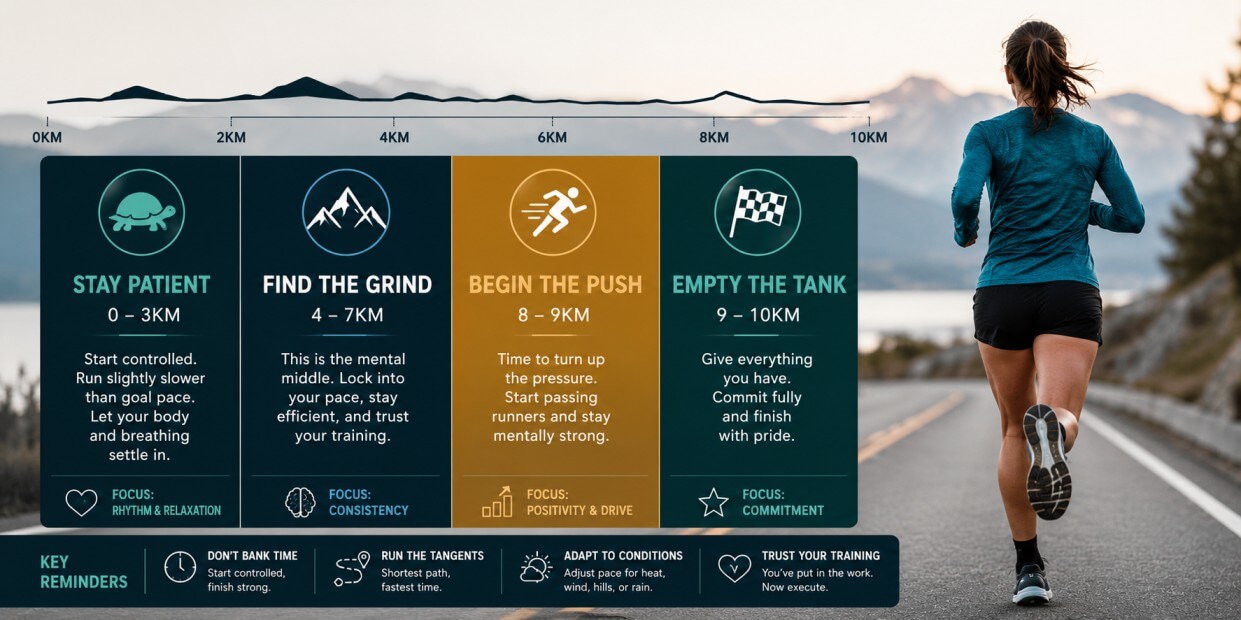
The 10K rewards runners who are willing to delay gratification.
A smart 10K rarely feels exciting in the opening miles.
The First 3K
The beginning of a 10K should feel controlled.
Many athletes make the mistake of treating a 10K like an extended 5K. The result is often a painful slowdown during the second half.
Trust your preparation and stay patient.
The Middle Kilometers
This section is where mental discipline becomes critical.
Focus on maintaining consistent effort, staying relaxed, and minimizing unnecessary fluctuations in pace. The athletes who remain steady here often finish strongest.
The Final Push
With roughly two kilometers remaining, begin increasing effort.
By this point, you should have a clear understanding of what remains in the tank. Gradually increase pressure and commit fully during the final kilometer.
A strong finish often creates significant momentum heading into future races.
Should You Always Aim For A Negative Split?
A negative split occurs when the second half of a race is faster than the first.
For many runners, particularly those newer to racing, this is an excellent goal.
Negative splitting encourages patience, reduces the likelihood of early mistakes, and often leads to stronger finishes. However, not every race will produce a perfect negative split.
Course profiles, weather conditions, competition, and race dynamics can all influence pacing.
Rather than obsessing over exact split patterns, focus on distributing effort intelligently across the entire race.
Race-Day Fueling Matters
Fueling becomes increasingly important as race distance increases.
For most runners, an 800m, mile, or 5K requires minimal race-day nutrition beyond normal pre-race preparation.
A 10K may require slightly more planning, especially if you’re racing for over an hour.
A few guidelines include:
- Eat familiar foods before the race
- Prioritize carbohydrates
- Stay hydrated leading into race day
- Avoid experimenting with new products
- Practice race-day nutrition during training
The best fueling strategy is one you’ve already tested.
Don’t Skip The Warm-Up
A proper warm-up prepares both your body and mind for competition.
Shorter races generally require more comprehensive warm-ups because they begin at a higher intensity.
An effective warm-up may include easy running, mobility work, drills, strides, and a few minutes to mentally settle before the start.
Think of your warm-up as the first step of the race itself.
Common Race-Day Mistakes
Even experienced runners make mistakes.
Some of the most common include:
- Starting too fast
- Ignoring weather conditions
- Running wide around turns
- Focusing too much on pace instead of effort
- Trying new shoes or nutrition products
- Waiting too long to increase effort
- Letting one bad split affect the rest of the race
Awareness of these mistakes can help you avoid repeating them.
If you’re working on becoming a more complete runner, our article on pacing, effort management, and long-term development through individualized coaching offers additional perspective on building sustainable performance improvements.
Practice Race Strategy In Training
Race execution should never be an afterthought.
Many of the skills required on race day can be developed during training.
Progression runs teach patience. Tempo workouts develop rhythm. Strides improve efficiency and finishing speed. Race-specific intervals help athletes become comfortable with target pace.
The more often you practice these skills, the more natural they become under pressure.
This is one reason why athletes working through a structured coaching process often see improvements beyond fitness alone. The ability to consistently execute becomes a trained skill.
At Microcosm Coaching, our coaches work closely with athletes through individualised training plans, daily feedback, and ongoing communication to help bridge the gap between fitness and performance. Whether you’re training for your first local 5K, pursuing a marathon personal best, building toward trail and ultra events, or preparing for mountain objectives, the goal remains the same: helping you become a more capable, confident, and independent athlete over time.
For runners interested in longer-term development, our insights on goal setting, sustainable training progression, and building aerobic fitness can provide additional context for how successful racing fits into a bigger athletic journey.
Final Thoughts
The best race strategy is not necessarily the most aggressive one.
It’s the strategy that allows you to use your fitness effectively, adapt to the realities of race day, and finish knowing you gave yourself the best opportunity to succeed.
Every race provides information. Some races result in personal records. Others reveal opportunities for growth.
Either way, successful runners view racing as part of a larger process. They learn, adjust, and continue moving forward.
When approached with patience, awareness, and purpose, every race becomes another opportunity to improve.