
July 14, 2026
A Guide To Mental Training For Endurance Athletes And Coaches
A marathoner reaches mile 20 and begins questioning whether the pace can be sustained. An ultrarunner leaves an aid station knowing several difficult climbs remain. A cyclist watches power fall during a long event, while a skimo athlete struggles to stay composed after a slow transition.
These moments may feel physical, but the mind strongly influences how an athlete interprets fatigue, responds to pressure, and chooses the next action. Mental training for endurance athletes develops the skills needed to manage those moments with greater awareness and confidence.
Mental strength is not the ability to ignore every warning signal or force your body forward at any cost. It is the ability to stay present, make sound decisions, adapt when circumstances change, and remain connected to the reasons you chose the goal.
What Is Mental Training For Endurance Athletes?
Mental training is the intentional practice of psychological skills that influence focus, confidence, emotional regulation, motivation, and decision-making.
Just as endurance develops through repeated physical training, mental skills become more reliable through consistent practice. Athletes who wait until race day to use visualization, self-talk, or breathing techniques may struggle to access those tools when pressure is highest.
Mental training can be incorporated into regular workouts, daily training reflections, race simulations, recovery periods, and conversations between athletes and coaches.
Mental Training Is More Than Mental Toughness
Mental toughness is often described as the willingness to keep pushing when an effort becomes uncomfortable. That can be valuable, but it represents only one part of mental performance.
A mentally skilled athlete also knows when to adjust the pace, change the fueling strategy, ask for support, or stop because something feels medically concerning. Good decision-making protects both the immediate performance and the athlete’s long-term relationship with sport.
The purpose is not to become emotionless. It is to respond to thoughts and emotions without allowing them to control every choice.
The Core Mental Skills For Endurance Performance
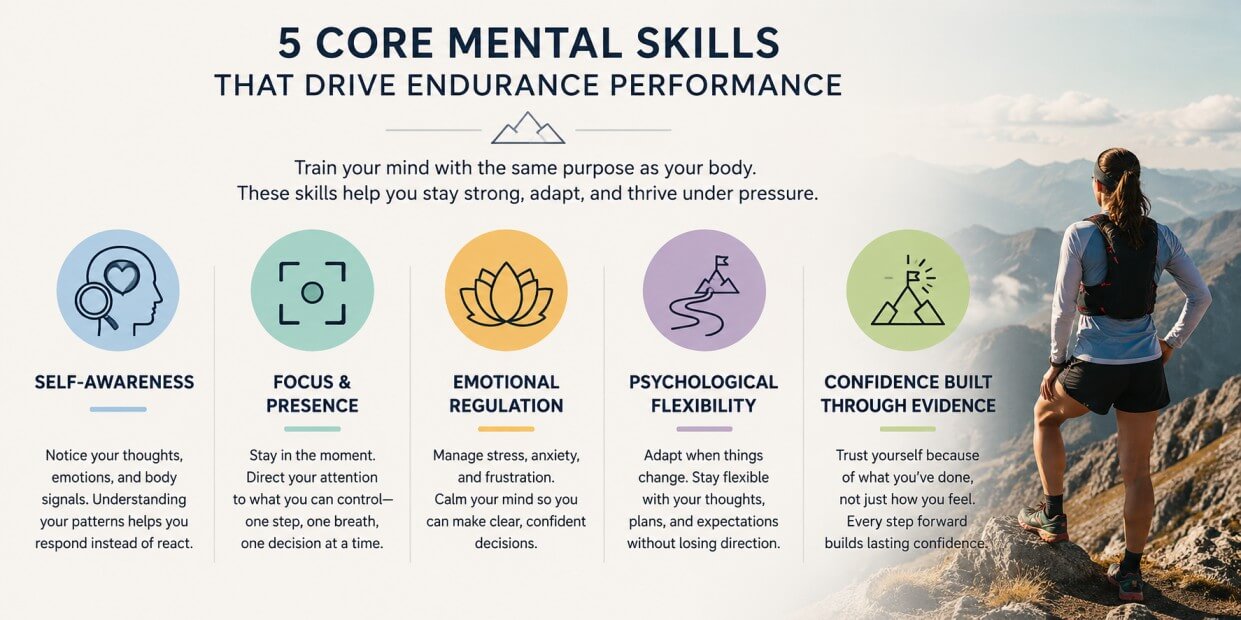
Mental strength is not a personality trait that some athletes naturally possess and others do not. It is a collection of trainable skills.
Different athletes will need to emphasize different areas depending on their goals, experiences, fears, and common challenges.
Self-Awareness
Self-awareness allows athletes to notice what is happening internally before an unhelpful thought becomes a damaging spiral.
Consider the difference between noticing, “My legs are getting heavy,” and immediately deciding, “I am falling apart.” The first statement describes a physical sensation. The second creates a story about what that sensation means.
During a difficult effort, athletes can ask:
- What am I thinking right now?
- What am I feeling emotionally?
- What information is my body giving me?
- What is the next useful action?
Daily workout reflections can make this process more natural. Over time, athletes begin recognizing patterns in how they react to fatigue, pressure, poor sleep, missed goals, and uncertainty.
Focus And Present-Moment Awareness
Endurance events become overwhelming when athletes mentally carry the entire remaining distance at once.
A runner at mile 18 of a marathon does not need to solve the final eight miles immediately. The current task might simply be to relax the shoulders, take fuel, settle the breathing, and reach the next mile marker.
Present-moment focus does not mean ignoring the larger race strategy. It means directing attention toward the part of the strategy that can be executed now.
Useful focus points include cadence, breathing, posture, power, effort, the next aid station, or the next section of terrain.
Emotional Regulation
Nerves, frustration, fear, and disappointment are normal parts of endurance sport. Mental training does not require eliminating those emotions.
Instead, athletes can practice naming the emotion, calming the immediate stress response, and choosing an action that supports the broader goal.
A few slow diaphragmatic breaths may help reduce mental clutter before a race start, after an unexpected setback, or during an intense workout. The goal is not to feel perfectly calm. It is to create enough space to respond intentionally.
Psychological Flexibility
Race plans matter, but endurance events rarely unfold exactly as expected.
Weather changes. Stomach problems appear. A pace that felt realistic during training may not match the conditions on race day. An athlete may sleep poorly, miss a bottle, or lose time during a transition.
Psychological flexibility allows athletes to adjust without interpreting every change as failure. A revised plan can still produce a meaningful performance.
This flexibility is especially important in ultra trail running coaching, where terrain, weather, fueling, and time on feet can create problems that no spreadsheet can predict perfectly.
Mental Training Techniques Athletes Can Practice
Mental skills become more useful when they are specific, believable, and connected to the demands of the athlete’s sport.
The following tools can be practiced during regular training rather than saved for competition.
Use Strategic Self-Talk
Self-talk is the language athletes use internally during training and racing. It can be motivational or instructional.
Motivational self-talk supports effort and confidence:
- I have handled difficult moments before.
- Strong and steady.
- Stay with the process.
Instructional self-talk directs attention toward an action:
- Relax the shoulders.
- Take fuel now.
- Shorten the stride.
- Breathe and settle.
Generic running mental toughness quotes may provide temporary inspiration, but personalized language is usually easier to trust under pressure. A good mantra should sound like something the athlete would genuinely say.
Practice Realistic Visualization
Visualization is not limited to imagining a perfect finish.
Athletes can mentally rehearse the course, pacing plan, transitions, fueling schedule, and desired emotional state. They should also visualize likely difficulties and how they will respond.
A marathoner might imagine reaching a late hill with tired legs, adjusting effort, and staying composed. A cyclist could rehearse responding to a power drop without panicking. A skimo athlete might visualize correcting a poor transition and returning attention to efficient movement.
Athletes working with a marathon coach can incorporate these scenarios into race-specific preparation alongside pacing, fueling, and taper planning.
Observe Thoughts Without Obeying Them
A difficult thought is not always a reliable instruction.
Instead of treating “I cannot do this” as a fact, an athlete can reframe it as, “I am noticing the thought that I cannot do this.”
That small shift creates distance between the thought and the next action. The athlete can then check effort, fuel, hydration, pain, and race conditions before deciding what to do.
The thought may still be present, but it no longer has complete control.
Break The Effort Into Smaller Segments
Chunking helps athletes reduce the mental weight of long events.
A marathon can become one mile at a time. An ultra can become one aid station at a time. A long climb can become a sequence of landmarks, while a bike race can be divided into fueling intervals or course sections.
The athlete is still completing the full event, but attention remains anchored to a manageable task.
Set Process Goals
Outcome goals such as a finishing time, podium position, qualification standard, or personal best can be motivating. However, they may also depend on weather, course conditions, competition, and other factors outside the athlete’s control.
Process goals focus on execution. Examples include starting conservatively, following the fueling plan, staying relaxed on climbs, checking effort regularly, or responding constructively to setbacks.
Process goals give athletes something meaningful to pursue even when the original outcome becomes less likely.
How To Practice Mental Skills During Training

Mental training does not always require a separate session. It can be built into the purpose of workouts already on the schedule.
Easy sessions offer space to practice breathing, body awareness, and present-moment focus. Hard workouts allow athletes to test self-talk and focus cues as discomfort increases.
Long endurance sessions are opportunities to practice patience, fueling decisions, chunking, and problem-solving. Selected race-specific workouts can also simulate terrain, pacing, elevation, or transitions.
This approach should remain progressive. Athletes do not need to repeatedly overwhelm themselves to become mentally stronger. The objective is to experience manageable challenges, respond effectively, and gradually build confidence.
An individualized trail running coach can help athletes introduce these demands in a way that reflects their terrain, experience, race goals, and current capacity.
Discomfort, Pain, And Knowing When To Adjust
Endurance athletes need to develop tolerance for discomfort, but they also need the awareness to identify potential warning signs.
Heavy breathing, muscular fatigue, and a strong desire to slow down can be normal during demanding efforts. Sharp pain, severe dizziness, confusion, chest pain, or a significant change in movement may require an athlete to stop and seek appropriate assistance.
Stopping a workout or race is not automatically evidence of weak mental toughness. Sometimes it is the decision that best supports future training and health.
When a difficult moment arrives, athletes can ask whether the discomfort is expected, whether their movement has changed, whether they have fueled properly, and whether reducing the intensity improves the situation.
Mental training should improve judgment, not teach athletes to disconnect from their bodies.
How Coaches Can Support Mental Training
Coaches influence how athletes interpret difficulty, setbacks, and performance. Their role extends beyond prescribing mileage, intervals, or power targets.
Athletes should be able to discuss fear, low motivation, self-doubt, life stress, and mistakes without being shamed. Psychological safety gives coaches more accurate information and helps athletes reflect honestly.
Useful post-workout questions include:
- What were you telling yourself during the hardest section?
- What helped you stay engaged?
- When did your focus begin to change?
- What did your body need?
- What would you try differently next time?
- What went well mentally, regardless of the result?
Coaches can also connect training to the athlete’s personal values. Courage, adventure, community, mastery, health, joy, and independence often provide more sustainable motivation than external validation alone.
At Microcosm Coaching, mental development is integrated into a human-first training process. Athletes receive individualized plans, complete regular check-ins, and work with coaches who consider training stress alongside work, family, recovery, confidence, and long-term goals. The multidisciplinary coaching team brings experience in road running, trail and ultra running, cycling, skimo, sports psychology, nutrition, strength, and sustainable performance.
A Simple Weekly Mental Training Routine
Athletes can begin with one mental skill rather than trying to change everything at once.
At the start of the week, identify one recurring challenge. This might be negative self-talk during intervals, anxiety before long runs, impatience early in races, or frustration when a plan changes.
Choose one focus cue and one believable mantra. Practice both during a workout that creates mild pressure. Afterward, write down what happened, what helped, and what should change.
Later in the week, spend five minutes visualizing a realistic race challenge and a constructive response. Review the experience with a coach or training partner, then select one action to carry into the following week.
Small, repeated practices are more valuable than waiting for a dramatic breakthrough.
Mental Strength Grows Through Consistency
Mental training for endurance athletes is not about becoming fearless, endlessly positive, or unwilling to stop.
It is about developing awareness, focus, emotional regulation, confidence, and flexibility. These skills help athletes remain engaged when training becomes difficult and make better decisions when racing does not go according to plan.
The strongest endurance mindset is not built through one heroic effort. It grows through daily reflection, manageable challenges, honest communication, and a willingness to keep adapting.
When athletes train the mind alongside the body, they become better prepared not only to pursue ambitious goals, but also to sustain their joy and independence throughout a long athletic life.
Frequently Asked Questions
Can Mental Toughness Be Trained?
Yes. Mental toughness can be developed through consistent practice with self-talk, visualization, process goals, mindfulness, progressive challenges, and post-workout reflection.
How Often Should Endurance Athletes Practice Mental Training?
Mental skills can be practiced several times each week within regular workouts. Short, consistent practices are often more useful than occasional long mental training sessions.
How Do You Stay Mentally Strong During A Marathon?
Focus on the current segment, follow your fueling plan, use personalized cues, monitor effort, and adjust your strategy when conditions change. Avoid mentally carrying the entire remaining distance at once.
Does Visualization Improve Endurance Performance?
Visualization can help athletes rehearse race demands, build familiarity with difficult situations, and prepare constructive responses to setbacks. It works best when practiced regularly and realistically.
What Should Runners Tell Themselves When They Want To Quit?
Use believable, action-oriented language such as “breathe and reassess,” “one mile at a time,” or “fuel, settle, move.” The best phrases direct attention toward the next useful action.
Is Stopping A Race A Sign Of Weak Mental Toughness?
No. Stopping may be a responsible choice when an athlete experiences concerning symptoms, injury, illness, or dangerous conditions. Mental strength includes making decisions that protect long-term health and performance.