
July 31, 2026
The Big List Of Running Goals
Running goals can give your training direction, but they do not all need to involve running farther or finishing faster. A meaningful goal might be completing your first mile, becoming more consistent, exploring a new trail, returning after an injury, or simply enjoying running again.
The best running goals reflect who you are, what motivates you, and what your life can realistically support. Whether you are taking your first steps as a runner or preparing for your tenth ultramarathon, this list can help you find a challenge that feels exciting, purposeful, and sustainable.
Why Setting Running Goals Matters
A clear goal can make it easier to decide what to do each week. Instead of running without direction or chasing every new training idea, you can build your routine around a purpose that matters to you.
Goals also give you opportunities to recognize progress. Finishing a race is worth celebrating, but so is completing a month of consistent training, recovering well, handling hills more confidently, or staying patient during a difficult season.
Healthy goals should support your motivation rather than make you feel as though you are never doing enough. The goal is not to prove your worth as an athlete. It is to create a training process that helps you grow.
How To Choose The Right Running Goal
Before selecting a goal, think about what you want running to add to your life. You may be seeking confidence, competition, adventure, community, stress relief, better health, or a chance to test your limits.
Your goal should also reflect your current schedule, training history, health, available recovery, and responsibilities outside running. An ambitious target can still be realistic when it is supported by enough time and a thoughtful plan.
Combine Outcome And Process Goals
An outcome goal describes the result you hope to achieve. You might want to finish a half marathon, qualify for Boston, complete a trail race, or set a personal record.
A process goal describes the actions that move you toward that outcome. Examples include running three times per week, completing strength training regularly, fueling during long runs, or writing a short reflection after each workout.
You cannot control every race-day result, but you can build confidence by consistently completing the smaller actions within your control.
Give Yourself Permission To Adjust
Changing a goal does not automatically mean you have failed. Work, family responsibilities, illness, injury, poor sleep, and unexpected stress can all affect how much training your body can absorb.
A strong goal provides direction while leaving room for flexibility. Adjusting your timeline or changing the target may be the smartest decision you make during a training cycle.
Running Goals For Beginners
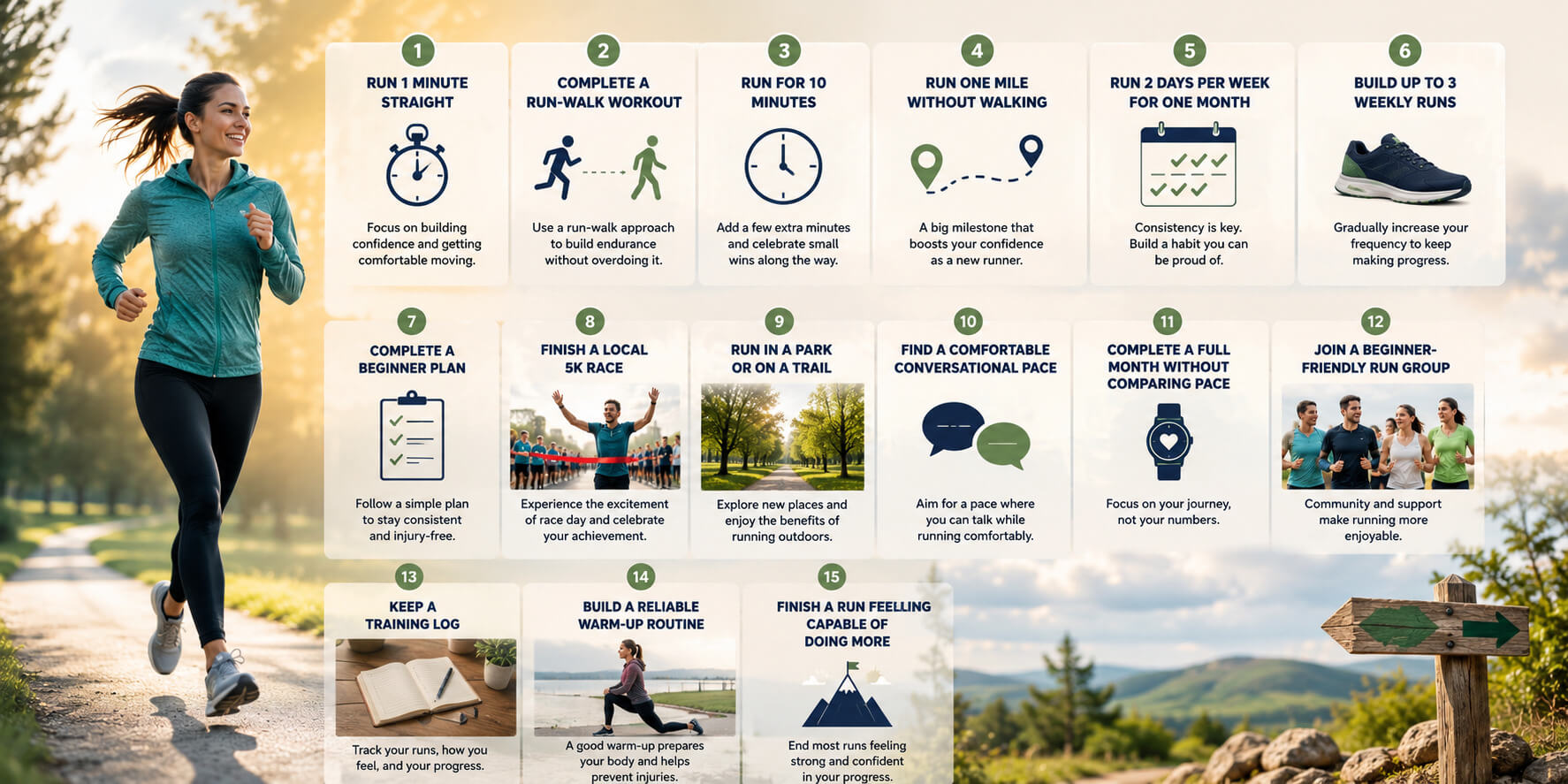
Beginner running goals should create confidence and consistency without demanding too much too soon. The early stages of running are about discovering what your body can do and building a routine you can maintain.
Consider working toward one of these milestones:
- Run continuously for one minute
- Complete a full run-walk workout
- Run for 10 minutes without stopping
- Run one mile without walking
- Run twice per week for one month
- Build up to three weekly runs
- Finish a beginner 5K training plan
- Complete your first local 5K
- Find a comfortable conversational pace
- Run outside in a new location
- Join a beginner-friendly running group
- Keep a training log for four weeks
- Complete a warm-up before every run
- Finish a run feeling like you could do more
Beginners often believe they need to run continuously from the start, but walking can be a valuable training tool. A patient run-walk progression can help you build aerobic fitness while keeping the experience manageable.
Running Consistency Goals
Consistency is one of the most valuable qualities a runner can develop. It is usually more productive to complete manageable training week after week than to alternate between intense bursts of activity and long periods away from running.
A consistency goal could involve running a certain number of days each week, completing a full training month, or staying active throughout an entire season. You might also set a minimum routine for stressful weeks, such as two short easy runs and one strength session.
Other useful consistency goals include preparing your gear the night before, logging every workout, checking in with your body after each run, and avoiding the urge to make up missed mileage.
Missing one workout rarely determines the success of a training cycle. Trying to squeeze missed miles into an already demanding week, however, can create unnecessary fatigue. Our perspective on why there are no make-up miles can help you respond to disrupted training more constructively.
Distance-Based Running Goals
Distance milestones are popular because they provide a clear target and a strong sense of accomplishment. Your next goal might be running farther continuously, completing a new race distance, or becoming more comfortable at a distance you have already covered.
Distance-based running goals include:
- Complete your first mile
- Finish a 5K
- Progress from a 5K to a 10K
- Run your first half marathon
- Complete a full marathon
- Finish a trail half marathon
- Complete your first 50K
- Run a 50-mile race
- Finish a 100K or 100-mile event
- Complete a long run at a new distance
- Run every street in your neighborhood
- Cover a meaningful route or local trail
Longer is not always better. A 5K can be a major endurance achievement for a beginner and a demanding performance challenge for an experienced runner. Choose a distance because it excites you, not because you feel pressured to keep moving toward an ultramarathon.
Speed And Performance Goals
Performance goals can add focus to your training once you have developed a consistent foundation. These goals may involve improving your pace, racing more strategically, or becoming more efficient across a particular distance.
You could aim to set a personal record in the mile, 5K, 10K, half marathon, or marathon. Another option is to run even splits, finish the second half faster than the first, improve your hill-running ability, or become more confident during tempo and interval workouts.
Performance does not have to be measured only by finish time. Holding a steadier effort, fueling more successfully, recovering faster, or making better decisions late in a race can all represent meaningful progress.
Runners who want to understand how different workouts support speed can explore the distinction between a tempo run and threshold run. Training becomes more effective when each session has a clear purpose.
Race-Day Running Goals
A race goal can give structure to months of training, but finishing time is only one possible measure of success. A runner may have several goals for the same event.
Your primary goal could be to finish, while your secondary goals might be to start patiently, fuel on schedule, stay present during difficult moments, or enjoy the course. This layered approach creates more ways to have a successful day, even when weather, terrain, or race conditions are not ideal.
Possible race goals include running your first organized event, racing without checking your watch constantly, completing a destination race, running for a charity, pacing a friend, or returning to an event that previously challenged you.
You can also set a strategy goal, such as controlling the opening miles or responding calmly when the race becomes difficult. A thoughtful race strategy for runners can help connect your training to the decisions you will make on race day.
Marathon Running Goals
The marathon attracts runners because it combines endurance, patience, planning, and uncertainty. Finishing your first marathon is a powerful goal, but it is only one of many ways to approach the distance.
You might aim to complete the race comfortably, avoid walking through the final miles, improve your fueling, run a negative split, set a personal record, qualify for a major event, or enjoy the entire experience more than you did previously.
Your marathon goal should influence how you train, but it should not tempt you to ignore recovery or force workouts when your body is asking for rest. Marathon progress is built through consistent aerobic work, purposeful intensity, fueling practice, and a plan that fits the rest of your life.
For runners deciding how much guidance they need, comparing a marathon coach with a training plan can clarify the difference between general structure and individualized support.
Trail And Ultrarunning Goals
Trail running goals can focus on distance, elevation, technical skill, exploration, or time spent moving through the mountains. The terrain makes pace less predictable, so effort, adaptability, and confidence often matter more than a specific number on the watch.
Trail and ultra goals might include:
- Run your first trail race
- Complete a technical descent confidently
- Improve your uphill hiking
- Gain a specific amount of elevation in one outing
- Explore a new trail every month
- Complete a trail marathon or 50K
- Practice fueling during a long trail run
- Finish your first overnight race
- Complete a 50-mile, 100K, or 100-mile event
- Stay mentally engaged during long solo efforts
- Prepare for heat, altitude, or mountain weather
- Become more efficient at aid stations
Ultrarunning requires more than accumulating mileage. Athletes must develop durability, fueling skills, pacing judgment, and the ability to adapt when the day does not unfold as expected. Working with an ultra trail running coach can help turn a big objective into a gradual, life-aware process.
Strength And Injury-Prevention Goals
Running goals should include the work that helps you stay healthy enough to keep running. Strength, mobility, sleep, nutrition, and recovery may not appear on a race result, but they strongly influence your ability to train consistently.
A practical goal could be completing two strength sessions per week, improving single-leg balance, strengthening your hips and calves, or maintaining a regular mobility routine. You might also prioritize eating after long runs, taking rest days seriously, or getting more sleep during demanding training blocks.
A well-designed strength routine for runners should support the specific demands of your running rather than simply leave you tired for the next workout.
Mental And Enjoyment-Based Running Goals
Not every running goal needs to be measurable. Some of the most valuable goals focus on how you experience training.
You could run without a watch once per week, stop comparing your pace with other runners, practice positive self-talk, or notice one enjoyable detail during every run. You might aim to respond to difficult workouts with curiosity rather than judgment.
Other goals include running purely for fun, taking photos during an adventure, listening to a favorite audiobook, volunteering at a race, or sharing more miles with friends.
Enjoyment is not a distraction from progress. It is often what makes long-term progress possible.
Community And Adventure Goals
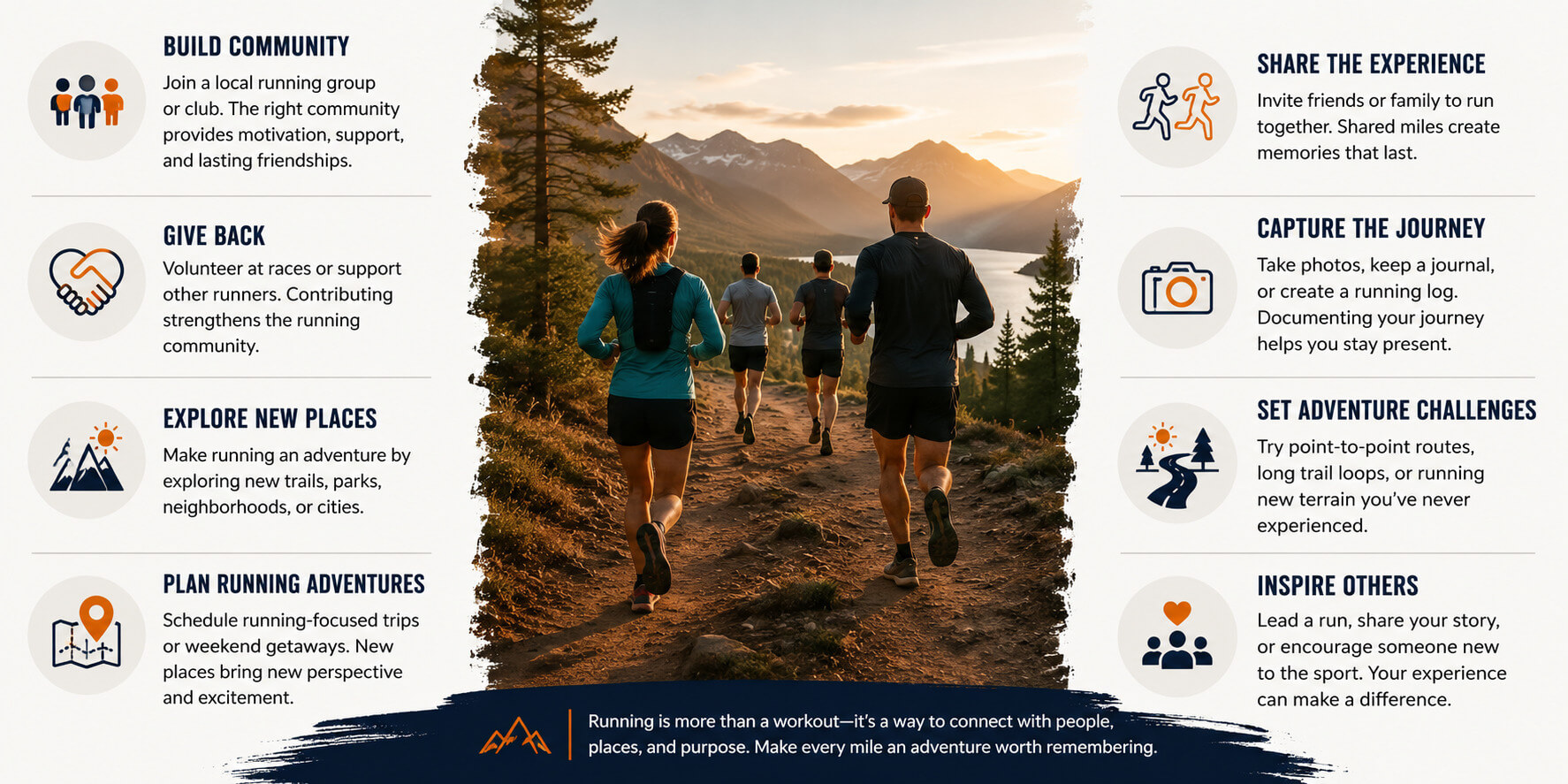
Running can create opportunities to connect with people and places in ways that extend beyond competition. A community-based goal may help you find new motivation while making the sport feel less solitary.
Try joining a local running group, volunteering at an aid station, supporting a friend at a race, organizing a social run, or introducing someone to the sport. You might also plan a running vacation, complete a point-to-point route, run at sunrise, or explore a new city on foot.
These goals remind us that running can be an experience rather than another obligation to complete.
Long-Term Running Goals
A long-term goal looks beyond the next race. It asks what kind of runner and person you want to become over several years.
You may want to remain active as you age, train consistently without repeated burnout, build confidence across different terrain, or develop enough knowledge to make better decisions independently. Another meaningful goal is creating a healthier relationship with competition, pace, body image, or rest.
Long-term progress rarely comes from one perfect training cycle. It comes from repeatedly making thoughtful decisions, staying curious, and accepting that growth includes setbacks and plateaus.
Microcosm Coaching supports runners with a human-first coaching philosophy that considers the complete person behind the training plan. Individualized programming, daily check-ins, coach feedback, and multidisciplinary expertise help athletes pursue ambitious goals while accounting for work, family, stress, recovery, and long-term well-being.
Turn A Big Goal Into Small Steps
Once you choose a goal, work backward from the outcome. Identify what needs to improve and which repeatable actions will help you get there.
For example, finishing a first half marathon may require gradually increasing weekly consistency, extending the long run, practicing fueling, and developing confidence at an easy effort. Each of those elements can become a smaller goal with its own timeline.
Review your progress regularly, but avoid judging the entire process based on one difficult workout. Training is rarely linear. A strong plan gives you direction while allowing you to respond to the feedback your body and life provide.
Choose A Goal That Keeps You Growing
The right running goal should create direction without taking away your joy. It can be ambitious, but it should also respect your current capacity and the life you are living outside the sport.
Start with one goal that genuinely matters to you. Break it into smaller actions, stay open to adjustment, and recognize the progress that happens long before race day. Big running dreams are often achieved through small, consistent choices repeated over time.
Frequently Asked Questions
What Are Good Running Goals For Beginners?
Good beginner goals include completing a run-walk session, running for 10 minutes continuously, finishing one mile, establishing a two- or three-day weekly routine, and completing a first 5K. The best starting goal is challenging enough to feel meaningful but manageable enough to support consistency.
How Do I Set A Realistic Running Goal?
Consider your current fitness, running history, schedule, health, stress, and available recovery. Choose an outcome goal, then identify the weekly actions that support it. Give yourself enough time to progress gradually and adjust the timeline when life or training circumstances change.
What Is A SMART Running Goal?
A SMART running goal is specific, measurable, achievable, relevant, and time-bound. For example, “I will run three days per week for the next eight weeks so I can build the consistency needed to finish my first 5K.”
Should My Running Goal Be Based On Time Or Distance?
It depends on what motivates you and where you are in your running journey. Distance goals can be helpful for beginners and endurance events, while time goals may appeal to runners pursuing performance. Consistency, enjoyment, strength, and recovery goals can be equally valuable.
How Many Running Goals Should I Have?
One primary goal and a few supporting process goals are usually enough. Too many competing targets can make training unfocused. Choose the outcome that matters most, then build smaller habits that directly support it.
What Should I Do If I Miss My Running Goal?
Review what happened without immediately treating the outcome as failure. The timeline may have been too aggressive, life circumstances may have changed, or the training approach may need adjustment. Use the experience to revise the goal and decide on a more sustainable next step.
Do I Need A Running Coach To Reach My Goal?
Not every runner needs a coach, but personalized coaching can be valuable when you want structure, accountability, feedback, or support navigating setbacks. A coach can adapt training to your schedule, experience, response, and changing life circumstances rather than asking you to follow a fixed plan.