
July 31, 2026
What Is the 80/20 Rule? How to Run Faster
Running faster does not require turning every workout into a race. In fact, consistently pushing the pace can leave you tired, frustrated, and unable to perform well when a workout is supposed to be challenging.
The 80/20 running rule offers a more sustainable approach. It suggests completing roughly 80% of your weekly training at a low, comfortable intensity and about 20% at a moderate or high intensity.
This balance helps runners build aerobic endurance while preserving enough energy for purposeful speed workouts. Instead of spending every run in the uncomfortable middle, you create a clear difference between easy days and hard days.
What Is the 80/20 Running Rule?
The 80/20 rule in running means that approximately 80% of your weekly training volume is completed at an easy intensity, while the remaining 20% includes faster, more demanding efforts.
The easy portion may include recovery runs, relaxed aerobic runs, and most long runs. The harder portion may include intervals, tempo runs, threshold workouts, hill repetitions, or race-specific efforts.
The percentages do not need to be mathematically perfect every week. The real goal is to make most running genuinely easy while using a smaller amount of focused intensity to develop speed, strength, and running economy.
This approach is often associated with polarized training because it creates separation between low-intensity and high-intensity work. That separation can help runners avoid accumulating unnecessary fatigue at a moderate effort.
Why Easy Running Can Help You Run Faster
Slowing down may feel counterproductive when your goal is to run faster. However, easy running develops many of the systems that support stronger performances over every distance.
Your aerobic system supplies most of the energy used during distance running. Building that system improves your ability to deliver oxygen, conserve energy, and maintain a sustainable effort for longer.
Easy Runs Build Your Aerobic Base
Consistent low-intensity running can support improvements in cardiac output, capillary density, mitochondrial development, and the body’s ability to use fat as fuel.
These adaptations help you maintain pace with less effort. Over time, the pace that once felt moderately difficult may begin to feel relaxed and controlled.
A strong aerobic base is important whether you are preparing for a first 5K, a road marathon, or a long mountain race. Runners looking for additional practical strategies can explore these tips for improving running speed and endurance.
Easy Runs Support Better Recovery
Hard workouts create the stimulus for improvement, but adaptation happens when your body has enough time and energy to recover.
Easy running allows you to continue developing fitness without placing the same demand on your muscles, connective tissues, and nervous system as a harder session.
That balance makes it easier to train consistently. Consistency over months is usually more valuable than completing a few impressive workouts followed by illness, injury, or burnout.
Easy Runs Improve Hard Workouts
When easy days are truly easy, you are more likely to arrive at intervals, hills, and tempo runs ready to perform well.
A runner carrying constant fatigue may complete every workout, but the quality of those sessions often declines. Paces become inconsistent, form breaks down, and the intended training stimulus becomes less clear.
Protecting recovery allows hard days to have a specific purpose rather than becoming another tired effort.
Avoid the Moderate-Intensity Trap
Many runners do not intentionally train hard every day. Instead, they gradually drift into a moderate pace that feels productive without being extremely uncomfortable.
This pace is often too fast to promote full recovery but not demanding enough to create the same adaptations as a properly structured speed workout. It can become a training gray zone.
Signs that you may be running too many moderate miles include:
- Feeling tired before most workouts
- Struggling to complete planned intervals
- Running nearly the same pace every day
- Experiencing frequent soreness or minor injuries
- Reaching a plateau despite consistent effort
- Losing motivation or enjoyment
The 80/20 running method helps create clearer boundaries. Easy days support endurance and recovery, while hard days target specific performance qualities.
What Should the Easy 80% Feel Like?

Easy running should feel relaxed and sustainable. You should finish most easy runs feeling as though you could have continued for longer.
There is no single easy pace that works in every situation. Your effort may change with hills, heat, humidity, altitude, poor sleep, or accumulated stress.
Use the Talk Test
The talk test is one of the simplest ways to monitor easy running intensity. You should generally be able to speak in complete sentences without gasping for breath.
If you can only say a few words at a time, your effort may be too high for an easy day.
Running with a friend can make this easier to assess. When running alone, briefly speaking a full sentence out loud can provide a similar check.
Use Perceived Effort
On a scale from 1 to 10, easy running often falls between 2 and 4. Your breathing is controlled, your stride feels comfortable, and the effort does not require intense concentration.
Perceived effort is particularly helpful on trails and hills, where pace may vary significantly even when your physiological effort remains steady.
Trail runners may also benefit from working with a personalized trail running coach who can account for elevation, terrain, technical difficulty, and race demands.
Use Heart Rate Carefully
Many runners associate the easy 80% with Zone 2 running. Heart rate can be useful, but only when your training zones are reasonably accurate.
Generic formulas do not reflect every athlete’s physiology. Heart rate can also rise because of heat, dehydration, fatigue, caffeine, stress, or altitude.
Use heart rate alongside breathing, perceived effort, and how your body feels. No single number should override clear signs that you need to slow down.
What Belongs in the Hard 20%?
The harder portion of your training should have a defined purpose. Running faster simply because you feel good does not always create a useful training session.
Different workouts develop different aspects of performance. The right combination depends on your experience, event, current fitness, and recovery capacity.
Tempo And Threshold Runs
Tempo and threshold workouts teach you to sustain a strong, controlled effort. They can improve your ability to manage lactate and maintain faster paces without quickly fading.
These runs should feel focused and demanding, but they should not become uncontrolled races. The distinction between the two workout types is explained further in this guide to tempo runs and threshold runs.
Interval Workouts
Intervals alternate faster repetitions with periods of easy jogging, walking, or rest. Depending on their duration and intensity, they can support speed, VO2 max, running economy, and race-specific fitness.
Examples include short track repetitions, longer aerobic intervals, and controlled repetitions at 5K or 10K effort.
The workout includes more than the fast repetitions. Your warmup, recovery jogging, and cooldown normally count toward the easier portion of your training.
Hill Repetitions And Fartlek Runs
Hill repetitions can develop strength, power, coordination, and efficient form. They are particularly useful for runners preparing for rolling courses, mountain races, or technical trails.
Fartlek workouts use changes in pace rather than rigid track distances. They provide a flexible way to introduce faster running and can be adjusted according to terrain and experience.
Short strides can also develop speed without producing much fatigue. These relaxed accelerations are helpful for runners who want to improve leg turnover while keeping most of the session easy.
Should You Calculate 80/20 by Time, Mileage, or Workouts?
The ratio can be calculated using time or distance. Training time is often the easiest method because it reflects how long your body spends working at each intensity.
Mileage can also work well for road runners who closely monitor weekly distance. However, mileage becomes less useful when comparing flat road running with steep trails or hiking.
Counting workouts is the simplest but least precise method. One interval session does not mean an entire five-run week automatically follows an 80/20 distribution because the length and structure of each session can vary.
Avoid becoming obsessed with exact percentages. A week that comes out to 78/22 or 85/15 can still reflect the same overall philosophy.
Sample 80/20 Running Week
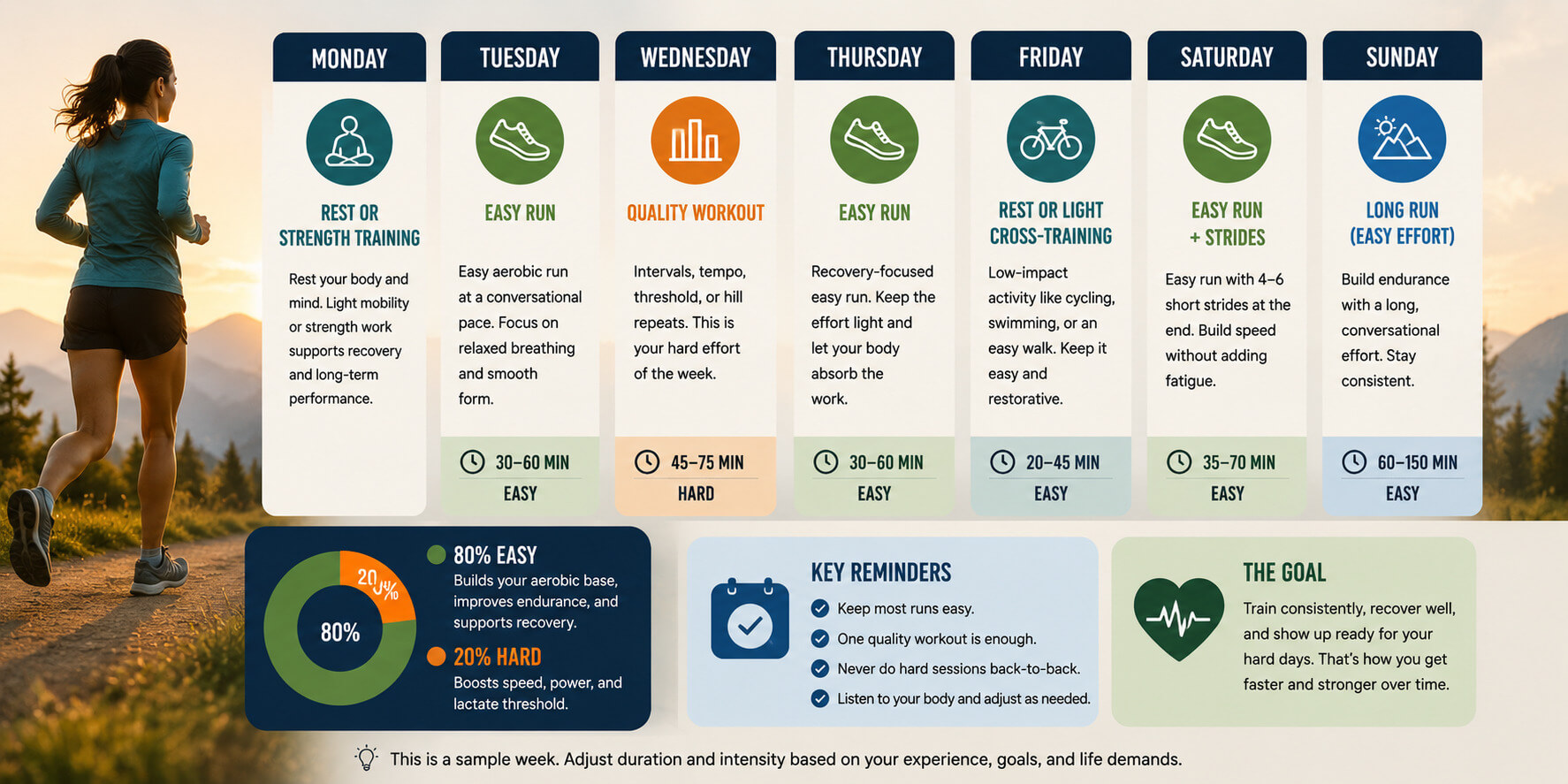
A five-day running schedule might include:
- Monday: Rest or strength training
- Tuesday: Easy aerobic run
- Wednesday: Interval or threshold workout
- Thursday: Easy recovery run
- Friday: Rest or light cross-training
- Saturday: Easy run with short strides
- Sunday: Long run at a conversational effort
This schedule includes one focused workout and four predominantly easy runs. The exact duration of each session should reflect your background, goals, and available recovery.
Runners training three days per week may use one easy run, one controlled workout, and one easy long run. More guidance is available in this breakdown of how many days per week you should run.
Does the 80/20 Rule Work for Beginners?
Beginners can benefit from the principle, but they may not need to complete a full 20% of their training at high intensity.
New runners often improve rapidly through consistent easy running alone. A distribution closer to 90/10 may be more appropriate while the body adapts to regular impact and training volume.
Short strides, gentle hills, and run-walk sessions can introduce variety without creating excessive fatigue. The goal is to build a routine that can be repeated safely rather than forcing speed before a foundation exists.
How 80/20 Training Changes by Race Distance
The overall principle can support many race distances, but the harder 20% should reflect the demands of the event.
A 5K runner may use shorter intervals, threshold work, and strides to improve speed and running economy. A half marathon runner may emphasize longer controlled efforts and aerobic strength.
Marathon training relies heavily on easy volume, long runs, fueling practice, and carefully placed race-pace work. A personalized marathon training coach can help balance those demands without turning every long run into a race simulation.
Trail and ultra runners must also consider vertical gain, technical terrain, hiking, descending, and time on feet. Pace becomes less useful on steep or rugged trails, so effort and recovery often provide better guidance.
Athletes preparing for long mountain events can explore ultra trail running coaching designed around terrain access, race demands, life stress, and long-term development.
Common 80/20 Running Mistakes
The 80/20 method is simple, but implementation still requires judgment.
Common mistakes include running easy days too fast, increasing mileage and intensity at the same time, using inaccurate heart rate zones, and treating every long run as a hard effort.
Other runners become overly rigid about the percentages. Training should respond to your body and circumstances. Illness, poor sleep, work pressure, travel, and family responsibilities may all justify reducing intensity.
Strength training also adds stress even though it is not usually calculated directly within the running ratio. Your entire training load matters, not only the minutes recorded as running.
A Human-First Approach to 80/20 Training
Microcosm Coaching uses individualized, evidence-based training to help runners develop fitness without losing their connection to the sport. Plans account for goals, schedules, training history, recovery, and the life stresses that influence how an athlete responds.
Through personalized plans, daily check-ins, regular feedback, and access to a multidisciplinary coaching community, athletes receive more than a fixed weekly schedule. Training can evolve as fitness grows and life changes.
The 80/20 rule provides a valuable framework, but the most effective plan is one adapted to the human completing it. When easy days support recovery and hard days have a clear purpose, runners can build endurance, improve speed, and continue progressing for years.
Frequently Asked Questions
What Is the 80/20 Rule in Running?
The 80/20 rule suggests completing approximately 80% of weekly running at an easy intensity and 20% at a moderate or high intensity. It is a flexible training guideline rather than a rigid mathematical requirement.
Does Running Slowly Really Make You Faster?
Easy running builds aerobic fitness, supports recovery, and allows you to complete speed workouts with greater quality. Over time, your easy pace may also become faster at the same perceived effort.
Is 80/20 Running Based on Time or Distance?
You can calculate the ratio by time or distance. Time is often more practical, especially for runners training on hills or trails where pace and mileage do not fully represent effort.
Is Zone 2 Training the Same as 80/20 Running?
No. Zone 2 describes an intensity range. The 80/20 rule describes how your total training is distributed between easier and harder intensities.
What Counts as the Hard 20%?
The harder portion may include intervals, tempo runs, threshold workouts, hill repetitions, fartleks, and race-specific efforts. Warmups, cooldowns, and easy recovery jogging generally remain part of the easy volume.
Do Long Runs Count as Easy Running?
Most long runs count as easy training when they are completed at a conversational aerobic effort. Long runs containing faster segments may include both easy and hard portions.
How Many Hard Workouts Should Runners Do Each Week?
Many recreational runners perform well with one or two quality workouts per week. Beginners and lower-volume runners may need only one, while experienced athletes may tolerate more depending on recovery and goals.
How Long Does It Take for 80/20 Running to Work?
Some runners notice improved recovery within a few weeks. Significant aerobic development and race improvement usually require consistent training over several months rather than a single training block.