
August 13, 2026
The Five Systems of Endurance Fitness Most Runners Need to Train
Runners often talk about fitness as though it is one thing. You are either fit or you are not. In reality, endurance performance is built from several systems working together, and a weakness in one can limit the strengths you have developed elsewhere.
A runner might have excellent speed but fade late in a marathon. Another might be able to run comfortably for hours but struggle to increase pace. Someone else may have strong aerobic fitness but repeatedly lose training time because their muscles and connective tissues cannot handle the workload.
As coaches, we find it more useful to think about five major components of endurance fitness: aerobic capacity, lactate threshold, running economy, durability, and musculoskeletal resilience. Each contributes something different, and the balance between them changes depending on your event, training history, and goals.
What Are the Components of Endurance Fitness?
The five key endurance fitness systems are aerobic capacity, lactate threshold, running economy, durability, and musculoskeletal resilience.
Together, they influence how much aerobic energy you can produce, how much of that capacity you can sustain, how efficiently you move, how well your performance holds up under fatigue, and whether your body can tolerate enough training to improve.
You do not need to maximize every system at the same time. Good endurance training develops different qualities at different points in the season.
System 1: Aerobic Capacity
Aerobic capacity is the size of your endurance engine. It reflects your ability to take in oxygen, transport it through the cardiovascular system, and use it in working muscles.
VO2 max is one measurement associated with aerobic capacity, but your watch’s VO2 max estimate does not tell the entire story.
How to Improve Aerobic Capacity
Most runners improve aerobic fitness by consistently accumulating low intensity training over time. Long runs, easy runs, and carefully placed aerobic intervals all contribute.
This is why building endurance usually starts with a lot of relatively comfortable running. Consistent aerobic work allows you to increase training volume without generating the recovery cost of constantly running hard.
A structured 80/20 running approach can help create that balance by keeping most weekly training easy while reserving a smaller amount for purposeful harder efforts.
Signs that aerobic capacity may be limiting you include unusually heavy breathing at moderate paces, struggling on sustained climbs, or finding that easy runs rarely feel genuinely easy.
System 2: Lactate Threshold
A large aerobic engine is valuable, but performance also depends on how much of that engine you can use for an extended period.
Lactate threshold is closely related to the intensity you can sustain before fatigue begins increasing much more rapidly.
Why Threshold Matters
Two runners can have similar aerobic capacity and very different race performances. The runner who can sustain a higher percentage of that capacity usually has an advantage over longer distances.
Threshold fitness is especially important for 10K runners, half marathoners, marathoners, and trail runners facing long sustained climbs.
Threshold training does not need to mean running as hard as possible. Controlled tempo efforts and longer intervals are usually much more useful than turning every workout into a race.
Understanding the difference between tempo and threshold running can help you target the right intensity instead of drifting into workouts that are simply hard for the sake of being hard.
System 3: Running Economy
Running economy describes how much energy your body needs to maintain a particular pace.
Think of two runners traveling at exactly the same speed. If one uses less oxygen and energy to hold that pace, that runner is more economical.
What Influences Running Economy?
Running economy is affected by many factors, including neuromuscular coordination, strength, tendon stiffness, training history, technique, and fatigue.
There is no single perfect running form that every athlete should copy. Efficient movement usually develops through a combination of consistent running and appropriate exposure to faster speeds.
Strides, short hills, strength training, and well designed faster sessions can all contribute to improved economy.
The practical value of running economy becomes obvious in longer races. Saving even a small amount of energy with each stride can become meaningful after thousands of steps.
System 4: Running Durability
Running durability asks a different question from traditional fitness measurements.
Instead of asking how fit you are when you are fresh, durability asks how much of that fitness is still available after you have already been running for a long time.
Why Durability Matters
A marathoner may look smooth and controlled at mile five but experience a significant change in pace, heart rate, form, and perceived effort by mile 22.
An ultrarunner may climb efficiently early in a race but lose power, coordination, and running economy after several hours.
That deterioration is part of durability.
You can improve fatigue resistance through consistent aerobic mileage, progressive long runs, race specific training, fueling, strength work, and adequate recovery.
Durability becomes increasingly important as race duration grows. Your fitness at the starting line matters, but your ability to preserve it often determines what happens late in the race.
System 5: Musculoskeletal Resilience
Your cardiovascular system may be ready for more training before your muscles, tendons, bones, and connective tissues are ready to handle it.
That is why musculoskeletal resilience deserves its own place in endurance fitness.
Why Strength Matters for Runners
Running is repetitive. Every stride requires your body to absorb force and then produce force again.
If the structures doing that work fatigue too quickly, training quality can decline even when your aerobic system still feels strong.
Strength training can support force production, movement quality, and resistance to muscular fatigue. It can also help runners tolerate hills, descents, higher mileage, and harder race specific sessions.
Effective strength coaching for runners should complement endurance training rather than compete with it. The goal is not to leave your legs destroyed after every gym session. The goal is to build a body capable of supporting the running you want to do.
Musculoskeletal resilience also develops through sensible mileage progression. Adding volume too quickly can create a mismatch between cardiovascular fitness and tissue tolerance.
Why One Strong System Cannot Fix Everything
One reason runners plateau is that they keep training the system they already enjoy or the one they are already good at.
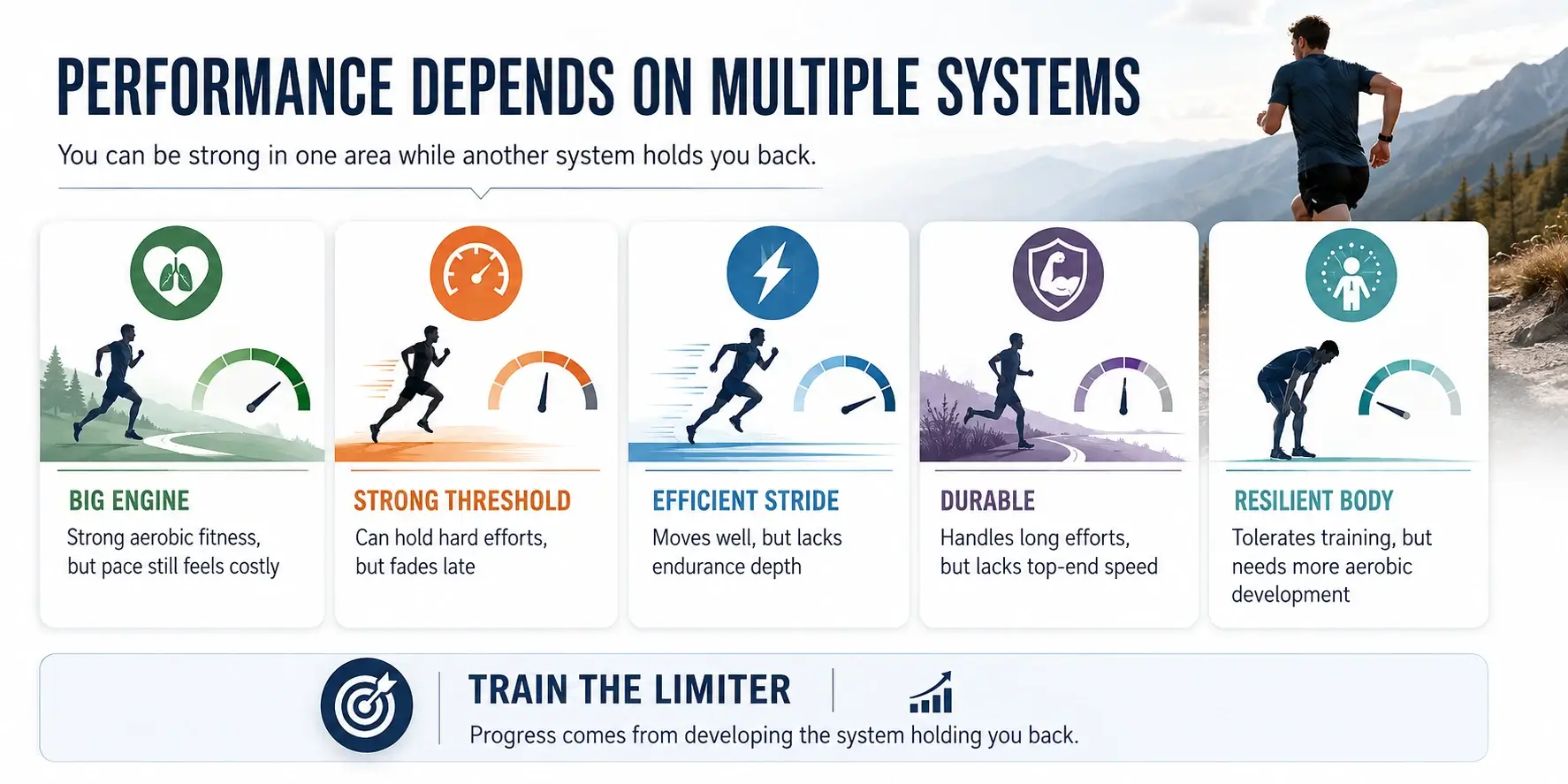
A naturally fast runner might continue chasing intervals even though durability is the real problem. A strong ultrarunner might keep adding easy volume when threshold development would provide a better return.
Consider a few common profiles:
- A runner with strong aerobic capacity but poor economy may work harder than necessary at every pace.
- A runner with excellent threshold fitness but weak durability may race well for an hour and fade badly after two or three.
- A runner with outstanding endurance but limited speed may need more economy and higher intensity work.
- A runner with good cardiovascular fitness but poor musculoskeletal resilience may struggle to train consistently enough to use that fitness.
The best training question is not, “What workout should I be doing?”
It is, “What is currently limiting my performance?”
How the Five Systems Work Together on Race Day
These systems do not operate independently.
Early in a race, aerobic capacity provides much of the engine while running economy influences how efficiently you use it.
As pace increases, threshold fitness affects how much of your aerobic capacity you can sustain.
As the race gets longer, durability becomes increasingly important because the same pace becomes more expensive as fatigue accumulates.
Musculoskeletal resilience supports everything. Your muscles and connective tissues must continue absorbing and producing force while the other systems are doing their jobs.
This is why endurance fitness cannot be reduced to one number on your watch.
You Do Not Need to Train Every System Hard Every Week
Trying to maximize all five systems simultaneously usually creates more fatigue than fitness.
Training works better when emphasis changes throughout the year.
During a base phase, a runner may prioritize aerobic development, strength, and general running economy. Later, threshold training can become more prominent.
As a goal race approaches, training may become increasingly specific to race pace, terrain, duration, fueling, and durability.
Recovery phases matter too. Fitness improves through cycles of stress and adaptation, not through continuous escalation.
How to Identify Your Weakest Endurance System
Your training history and race patterns often provide clues.
You may need more aerobic development if easy running consistently feels harder than expected.
Threshold may be limiting you if you have good short distance speed but struggle with sustained moderate to hard efforts.
Running economy may need attention if you have strong cardiovascular fitness but use a lot of energy at paces that should feel manageable.
Durability may be the issue if you race well early but repeatedly fade during the final stages of marathons, ultras, or long training runs.
Musculoskeletal resilience may be your limiter if your cardiovascular fitness improves faster than your body can tolerate increased mileage or training intensity.
Most runners have more than one area that could improve. The key is deciding which deserves priority now.
What a Balanced Training Week Can Look Like
Many sessions influence more than one system, so you do not need five separate workouts.
A balanced week might include:
- Tuesday: Threshold or interval workout
- Wednesday: Easy aerobic run
- Thursday: Easy running with strides and strength
- Saturday: Long aerobic run
- Sunday: Easy recovery
The threshold workout targets sustainable speed. Easy mileage builds aerobic capacity. Strides support economy. The long run develops aerobic fitness and durability. Strength supports musculoskeletal resilience.
The exact structure should change with your experience, race distance, available time, recovery, and life stress.
Build the Runner, Not Just the Metric
Endurance performance is the result of several systems working together over time.
A high VO2 max alone does not make a complete runner. Neither does a huge long run, a fast threshold workout, or an impressive strength session.
Microcosm Coaching builds individualized training around the athlete rather than one fitness metric. Our coaches consider training history, race demands, recovery, nutrition, injury history, schedule, and life stress when deciding which qualities deserve attention. Personalized online running coaching allows those priorities to change as the athlete develops instead of forcing the same training formula year round.
The goal is to build the aerobic capacity to produce energy, the threshold to sustain it, the economy to use it efficiently, the durability to preserve it, and the resilience to keep training consistently.
That is endurance fitness.
Frequently Asked Questions
What Are the Five Components of Endurance Fitness?
Five useful components for runners are aerobic capacity, lactate threshold, running economy, durability, and musculoskeletal resilience. Together, they influence how much work you can produce, sustain, and preserve as fatigue builds.
What Is the Most Important Component of Endurance Fitness?
There is no single most important component for every runner. The priority depends on your race distance, training history, strengths, weaknesses, and current phase of training.
How Can I Improve My Endurance for Running?
Most runners improve endurance through consistent easy running, progressive long runs, appropriate threshold and interval work, strength training, fueling, and adequate recovery.
Is VO2 Max the Same as Aerobic Fitness?
No. VO2 max is one measurement related to aerobic capacity, but endurance performance also depends on threshold, economy, durability, strength, and many other factors.
Does Strength Training Improve Endurance?
Strength training can support running economy, force production, movement quality, and resistance to muscular fatigue. It works best when integrated carefully with your running schedule.
Can You Have Good Endurance but Poor Running Economy?
Yes. A runner may be capable of exercising for a long time while still using more energy than necessary at a given pace. Improving running economy can help that runner move faster without proportionally increasing effort.